
Reflections from Theatre: Skill, Teamwork, and Perspective in Spine Surgery. (Stuart Robbins)
Reflections from Theatre: Skill, Teamwork, and Perspective in Spine Surgery.
Author: Dr Stuart Robbins (Osteopath)
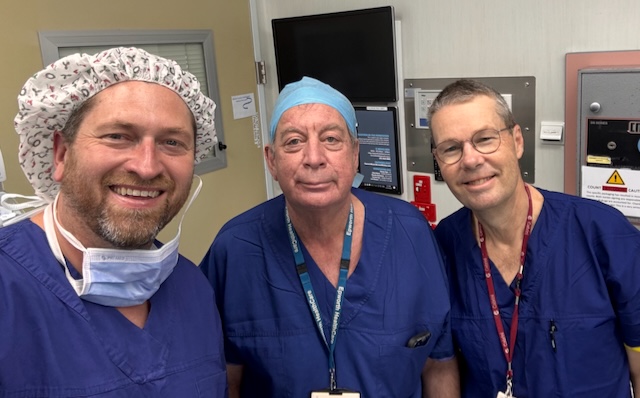
Recently, I had the opportunity to observe four spinal surgeries performed by Mr David De La Harpe, alongside his long-standing assistant surgeon Mr Tim Hurren. I was invited into theatre by Mr De La Harpe, and I am mindful that this was a generous and individual opportunity rather than a routine or widely available experience.
The invitation arose through a personal connection. My mother previously worked in theatre with Mr De La Harpe, and when I later required spinal surgery myself, he became the surgeon involved in my care. It is likely that this existing familiarity afforded me the opportunity to observe his work in this way.
As an osteopath, and as someone currently recovering from recent spinal surgery, the experience offered insight not only into surgical technique, but into the judgement, teamwork, and professional presence required across very different patient presentations.
Notably, the surgeons I observed were the same surgeons who had performed my own operation only weeks earlier. Observing their work from the other side of the drapes added a unique and grounding perspective that blended professional curiosity with personal appreciation.
At a time when I am temporarily unable to treat patients, I have been using the opportunity to broaden my exposure to other aspects of healthcare and deepen my understanding of other disciplines. Observing surgery in this context felt both professionally valuable and personally meaningful.
I was met at reception, escorted through a labyrinth of hallways, I changed into scrubs, was welcomed into theatre, and introduced to the broader surgical, anaesthetic, nursing, and theatre technical team. From the outset, there was a calm professionalism in the room that reflected trust, repetition, and shared experience.
Preparation, Presence, and Responsibility
Before the first surgery began, I became aware of the different ways responsibility is carried within the theatre. Mr De La Harpe’s pre-operative presence was calm, contained, and highly focused. There was a sense of deliberate mental rehearsal, an internal settling that reflected the weight of accountability inherent in his role as lead surgeon.
Rather than feeling disengaged, this quiet focus conveyed trust in the team around him and in the systems already in place. Communication was precise and intentional, with no unnecessary words, creating clarity and readiness rather than distance.
Alongside this, Mr Hurren, in his role as assistant surgeon, demonstrated a more outwardly communicative leadership style. He engaged readily with nursing staff, theatre technicians, and the anaesthetic team, helping to align the broader group and maintain a sense of shared awareness and flow within the room. The contrast was not hierarchical, but complementary, two different expressions of leadership serving the same outcome.
This preparation extended beyond mindset alone. Using a marker, anatomical landmarks were carefully identified and marked on the patient, and the limb associated with radicular symptoms was clearly indicated. These visible cues acted as both practical guides and deliberate safety measures, reinforcing intention before any incision was made.
The wider team then participated in a structured pre-operative check. The patient’s identity, the planned procedure, and the surgical site were read aloud and confirmed, bringing the entire theatre into alignment. This shared moment of verification highlighted that responsibility for patient safety is collective, not individual.
Rather than feeling procedural or routine, these steps carried a sense of respect for the patient, for the process, and for the seriousness of what was about to unfold. Observing this layered preparation reinforced how effective surgical leadership is expressed not only through technical authority, but through presence, communication, and the ability to bring a team together around a shared purpose.
The parallels to clinical practice outside the theatre were hard to miss. While osteopathic treatment rooms may appear quieter or more solitary, the same principles of preparation, intention, and presence remain central to good care.
Observing this dynamic also prompted personal reflection. While I can be animated in everyday settings, when I step into the treatment room I make a conscious effort to slow my pace and settle my focus. I often remind myself that this is the patient’s time, and that I am there to hear them, to listen, and to listen again. Presence in clinical work often requires less outward expression and more internal clarity, particularly when responsibility is high.
Team Cohesion and Leadership in Action
Beyond the surgeons themselves, there was a strong sense of cohesion within the wider theatre team. Communication flowed easily between surgeons, nursing staff, theatre technicians, and the anaesthetic team, contributing to a shared sense of readiness before and during each procedure.
Throughout the session, there was also an undercurrent of concern for a colleague working in another theatre who had reportedly collapsed or fallen earlier in the day. Details emerged gradually, but what stood out was the genuine care expressed across the team. Quiet check-ins and shared concern for their colleague’s wellbeing were a reminder that even in high-pressure, highly technical environments, people remain attentive to one another. The culture of care extended beyond the immediate surgical task.
Synergy in Action
Across all four surgeries, the synergy between Mr De La Harpe and Mr Hurren was consistent and unmistakable. It was something I noticed very early in the session and then continued to observe throughout the day.
At times, their heads were almost touching as they worked over the patient, both focused on the same operative field and moving seamlessly in and out of each other’s space. There was a rhythm to their movements. Instruments were exchanged with minimal words, and actions were anticipated rather than directed.
It often felt as though four hands were operating as part of a single coordinated system rather than two separate individuals.
At various points throughout the day, Mr Hurren would refer to Mr De La Harpe simply as “the boss”, a small but telling acknowledgement of experience, leadership, and trust, expressed with warmth rather than formality.
During one procedure, Mr Hurren also expressed genuine admiration for a moment of technical adaptability. When access was limited and an instrument could not be comfortably positioned with the right hand, Mr De La Harpe calmly switched hands, altered his angle, and completed the task with precision. It was an understated moment, yet a powerful demonstration of ambidexterity, spatial awareness, and experience, qualities refined over time and I suspect difficult to teach.
Teamwork Beyond the Room
Observing surgical teamwork so closely also prompted reflection on how teamwork manifests in osteopathic practice. Unlike the operating theatre, where multiple clinicians work simultaneously around a single patient, most osteopaths practise alone in their treatment rooms.
Yet this does not mean our work is isolated.
In osteopathy, teamwork often lives in communication, shared learning, and continuity of care rather than simultaneous hands-on intervention. Case discussions, mentoring, patient crossovers, and thoughtful handovers all form part of how we support one another clinically.
Beyond our own profession, effective osteopathic practice relies on collaboration with the broader interdisciplinary team, including general practitioners, podiatrists, Pilates instructors, exercise physiologists, and reception staff, all of whom play a vital role in patient care.
The surgical environment highlighted not a model to replicate directly, but a principle to translate. Teamwork does not require multiple people in the room at once. It requires clarity of roles, mutual respect, shared goals, and consistent communication.
The First Surgery: Precision, Anatomy, and Judgement
The first procedure, an anterior cervical discectomy and fusion (ACDF), was the one I found most technically fascinating. The patient was a young, muscular male, and at first there was something almost striking about the idea of addressing a cervical problem from the front of the neck. I remember thinking how remarkable it was that the pathology could be approached in this way, before quickly being reminded just how much critical anatomy occupies that space.
At the beginning of the procedure, fluoroscopy was used to confirm positioning, with lead protection donned and non-essential staff stepping out of the theatre. It was at this point that I became more aware of the cumulative radiation exposure surgeons accept as part of their work, a quiet and often unseen aspect of surgical responsibility that underpins accuracy and safety.
As I observed more closely, I reflected on the key structures that must be carefully protected, including vascular and neural elements, the airway and oesophagus, the borders of the sternocleidomastoid, and the recurrent laryngeal nerve. The approach highlighted how success in this region depends as much on respect for anatomy as it does on technical execution.
The patient’s muscular build also influenced the procedure. Longer retractors and instruments were required at various stages, reinforcing that surgical technique must continually adapt to individual anatomy rather than follow a fixed template.
I was particularly struck by the mechanical precision of the technique. Caspar pins were placed into the vertebral bodies and used in multiple ways throughout the procedure. Initially, a traction device was applied to these pins to create controlled separation between the vertebrae, allowing access to the disc space without the need for sustained manual force.
Following removal of the disc material, careful consideration was given to cage size and fit, with trialling and assessment undertaken before the final implant was selected and inserted. Once appropriate spacing and positioning were confirmed, the same pins were removed, and the channels they had created effectively became pre-drilled pathways for application of the anterior plate, stabilising the construct and reducing the risk of anterior migration.
Complexity, Perspective, and Recovery
The second surgery involved an elderly gentleman with a history of prior spinal surgery and additional degenerative change, including a cyst contributing to posterior compression at the lumbar level. In discussion with Mr De La Harpe following the procedure, the focus turned to the importance of managing patient expectations.
We spoke about the role of patient education and the challenge of finding the right balance between preserving function as the primary goal, while acknowledging that complete pain resolution may not always be achievable. It reinforced how expectation management is a critical component of care across all areas of healthcare, not only surgery.
The final two procedures, L5–S1 microdiscectomy and laminectomy, were similar to my own recent operation, though performed one level below. Observing these cases was unexpectedly personal and deepened my appreciation for tissue handling, closure, and the patience required during recovery.
As the day progressed, I became increasingly aware of my own healing incision and its residual tenderness, as well as my reduced tolerance for prolonged standing. While I was able to alternate between sitting and standing and continue observing the operative field via the monitors, it heightened my awareness of the physical demands placed on surgeons, who remain standing at the operating table for extended periods. Whether psychosomatic or not, the experience reinforced my respect for the endurance required in surgical practice.
Reflections for Practice
This experience reinforced several principles I carry back into osteopathic practice:
- Precision begins with preparation and confirmation
- Respect for anatomy is paramount
- Teamwork underpins all good outcomes
- Expectation management is as important as intervention
- Function and safety often matter more than pain alone
- Healthcare work is physically demanding and deserves respect
Gratitude
I am deeply grateful to Mr David De La Harpe, Mr Tim Hurren, David’s PA Greg Frost and the entire theatre, nursing, anaesthetic, and technical team for welcoming me into their environment and sharing their expertise so openly.
It was a privilege to observe, to learn, and to reflect.
Recent Comments