Heel Pain – Severs Disease

Heel Pain – Severs Disease

Why does my child’s heel hurt?

Understanding Sever’s Disease (Calcaneal Apophysitis)

“Mum… my heel hurts.”

For many parents, that’s how the story begins.

At first it’s only mentioned after basketball training or a weekend football game. A few days later your child starts limping as they walk back to the car. Then one morning they complain their heel is sore as soon as they get out of bed, only to seem much better later in the day.

You begin wondering whether they’ve bruised their heel, whether they’re simply going through a growth spurt, or whether they’re going to have to stop playing the sport they love.

If that sounds familiar, you’re certainly not alone.

At Gateway Osteopathy in Eltham, heel pain is something we assess regularly in active children. Being located close to the Eltham Wildcats, Australia’s largest junior basketball club, we frequently see young basketballers with this presentation. We also regularly assess footballers, soccer players, netballers competing in the Diamond Valley Netball Association, lacrosse players and children involved in athletics, dance and other running sports.

One of the most common causes of heel pain in these young athletes is Sever’s disease, also known as calcaneal apophysitis.

Despite the name, Sever’s disease isn’t actually a disease, and it isn’t something your child has “caught.”

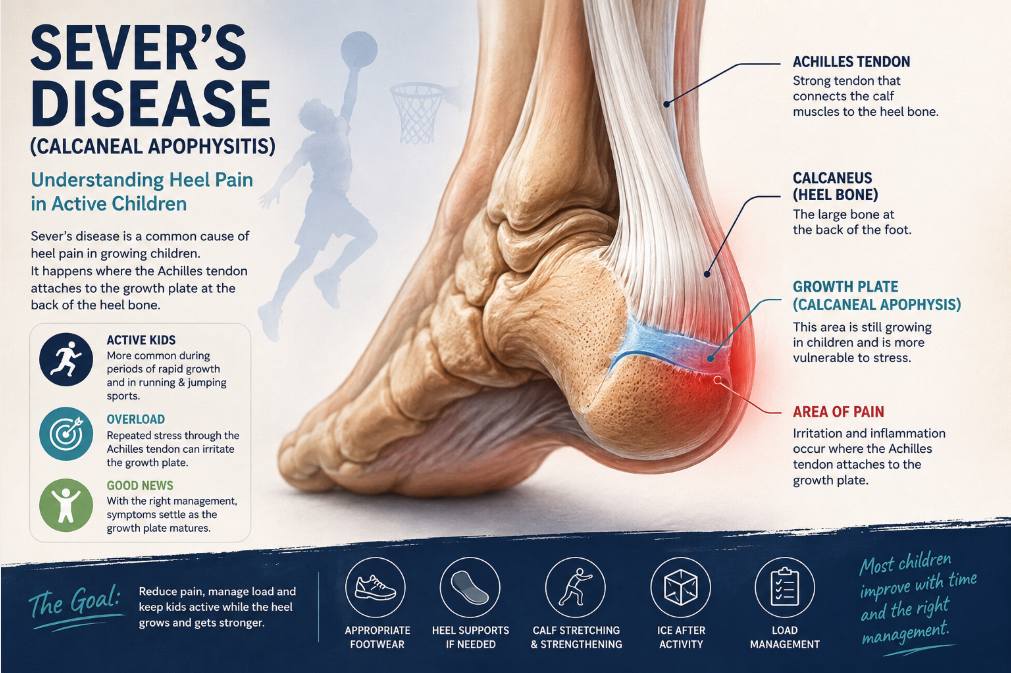
It’s a temporary irritation of the growth plate at the back of the heel that commonly develops during periods of rapid growth in active children.

The first thing I usually tell parents is not to panic.

Although Sever’s disease can certainly be painful and frustrating, it does not permanently damage the heel. In the overwhelming majority of children, symptoms settle as the growth plate matures, although they may come and go during periods of rapid growth and increased sporting activity.

The good news is that children are remarkably resilient. With the right advice, sensible activity modification and a little patience, most are back enjoying the activities they love without any lasting problems.

The challenge usually isn’t whether your child will recover.

The challenge is understanding why the pain has developed, why it seems to come and go, and how to help them remain involved in the sports they love while their symptoms settle.

That’s exactly what this guide is designed to help you understand.

My Clinical Tip

One of the things I’ve learnt over the years is that parents often arrive feeling guilty that they may have “missed something” or “left it too long.”

Fortunately, that’s rarely the case.

Most children continue playing sport for weeks before anyone realises the heel pain isn’t simply settling on its own. The important thing isn’t how quickly the condition is recognised, but understanding what’s happening and having a sensible plan to move forward.

      The most common cause of heel pain in active children aged 8–14 years.<br />

      Why does it happen?

      One of the first questions parents ask is:

      “Why has this suddenly started?”

      In reality, it often hasn’t.

      Sever’s disease usually develops gradually rather than appearing overnight. Many parents tell me their child complained of heel pain once or twice after sport before the symptoms slowly became more frequent. Looking back, they often realise there wasn’t one particular injury at all.

      Instead, it’s usually a combination of growth and load.

      During childhood, the heel bone is still developing. At the back of the heel is a growth plate (called the calcaneal apophysis) where the Achilles tendon attaches. While this area is growing, it appears to be more sensitive to the repeated forces created by running, jumping and changing direction.

      Now think about the typical week of an active child.

      They might train with the Eltham Wildcats during the week, play a game on the weekend, kick the football in the backyard, run around at school during lunchtime, then spend Sunday riding bikes or jumping on the trampoline with friends.

      None of those activities are a problem on their own.

      In fact, they’re exactly the sort of activities we want children to enjoy.

      However, when they’re combined with a period of rapid growth, the developing heel can sometimes struggle to keep up with the demands being placed upon it.

      One explanation is that during a growth spurt, bones can grow a little faster than muscles and tendons are able to adapt. The calf muscles may become relatively tighter for a period of time, increasing the pull of the Achilles tendon where it attaches to the growing heel.

      For children who love running and jumping sports, that extra demand may be enough to irritate the growth plate.

      Although we commonly see Sever’s disease in young basketballers from the Eltham Wildcats, the pattern is remarkably similar across many sports. Footballers, netballers competing in the Diamond Valley Netball Association, soccer players, lacrosse players, gymnasts, dancers and track athletes all place repeated load through the heel.

      The sport itself isn’t usually the problem.

      It’s the combination of a growing body and repeated loading that often explains why symptoms develop.

      One of the things that can make Sever’s disease confusing is that it rarely follows a straight line.

      Your child may have two or three excellent weeks before the pain suddenly returns after a basketball tournament, a school athletics carnival, a weekend away full of activity or simply another period of rapid growth.

      That doesn’t necessarily mean the condition is getting worse.

      More often, it’s the heel reminding us that it’s being asked to cope with more than it’s currently comfortable managing.

      My Clinical Tip

      One of the first questions I’ll often ask is whether your child has grown noticeably over the last six to twelve months.

      Parents are frequently surprised when they realise the heel pain started around the same time they needed a new pair of school shoes or their sports uniform suddenly became too small.

      It isn’t unusual for a parent to pause for a moment before saying,

      “Now that you mention it, he’s grown about five centimetres since Christmas.”

      Those observations don’t diagnose Sever’s disease, but they often provide valuable context and help explain why symptoms seem to have appeared out of nowhere.

      For that reason, I often encourage families to continue one of those wonderful traditions many of us grew up with—marking children’s heights on the back of a wardrobe or pantry door.

      As children get older, those pencil marks often become a source of family nostalgia. Grandparents compare their heights, siblings compete to see who’s catching up, and parents remember when they were measured in exactly the same place.

      Interestingly, those marks can also become a surprisingly useful record of growth. Looking back, many families realise their child had grown several centimetres in the months leading up to the onset of heel pain.

      Understanding the relationship between growth and activity helps explain why symptoms often come and go. More importantly, it helps parents understand why management is usually about temporarily modifying activity rather than avoiding it altogether.
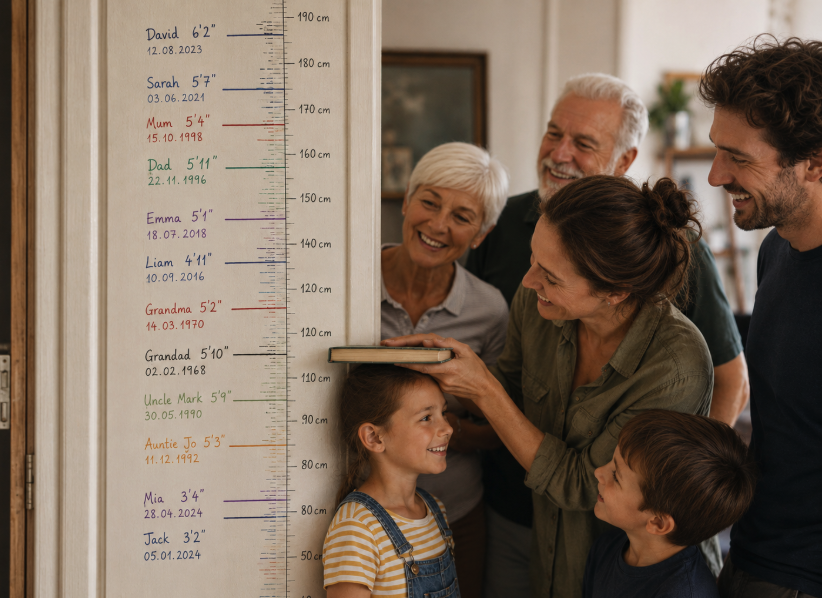
      Growth spurts often provide valuable context when trying to understand why heel pain has developed.<br />

      Could it be Severs Disease?

      One of the reasons Sever’s disease can be confusing is that it doesn’t always behave the way parents expect.

      Unlike many injuries, children often continue to run, jump and play sport despite having quite significant heel pain. It’s often only afterwards that they begin to complain.

      Parents frequently tell me things like:

      “He was fine during basketball, but he was limping back to the car afterwards.”

      “She says it only hurts after netball.”

      “He wakes up sore in the morning, but by the time he’s at school he seems much better.”

      “We thought he’d just bruised his heel.”

      “It started in one heel, but now the other one is beginning to hurt as well.”

      If you’ve heard your child say something similar, Sever’s disease may be one possible explanation.

      Typically, the pain is felt around the back or underside of the heel and is aggravated by running, jumping and repeated changes of direction. Some children notice stiffness when they first get out of bed, while others are more aware of discomfort after sitting for a while before getting up again.

      One of the most frustrating aspects for families is that symptoms often fluctuate.

      Your child may seem almost completely better one week, only to experience another flare-up after a basketball tournament, a busy weekend of sport or another noticeable growth spurt.

      Fortunately, that doesn’t necessarily mean they’re going backwards.

      It often simply reflects the changing demands being placed on a growing body.

      How Do We Diagnose Sever’s Disease?

      One of the most reassuring parts of an assessment is finally understanding why your child’s heel is sore.

      Before I even examine the heel, I’ll usually spend time talking with both you and your child.

      I’ll ask when the pain started, whether they’ve grown recently, what sports they play, whether their training load has changed, what activities aggravate the pain and whether anything seems to make it feel better.

      Sometimes the answers come from parents.

      Sometimes they come from the child.

      Both perspectives are important.

      The examination itself involves much more than simply pressing on the sore area.

      I’ll assess where the pain is located, look at ankle movement, calf flexibility, foot posture and walking, and where appropriate, watch your child move. I’ll also consider factors such as footwear, recent changes in activity and anything else that may be contributing to the load through the heel.

      The aim isn’t simply to put a name on the problem.

      It’s to understand why this particular child has developed symptoms and what practical changes are most likely to help.

      Do All Children Need an X-ray?

      Usually not.

      Sever’s disease is most commonly diagnosed from your child’s history and a thorough physical examination.

      In fact, the appearance of the heel growth plate on an X-ray varies considerably between healthy children, meaning an X-ray often doesn’t provide a clear answer on its own.

      However, there are situations where imaging or referral is appropriate.

      If your child’s symptoms aren’t following the typical pattern, the pain is in an unusual location, they’ve experienced a significant injury, or there are findings that suggest another condition may be present, I’ll discuss whether further investigation is warranted and communicate with your GP or another healthcare professional where appropriate.

      How Do We Know It Isn’t Something Else?

      Parents ask me this question all the time, and it’s a very reasonable one.

      Although Sever’s disease is one of the most common causes of heel pain in active children, it certainly isn’t the only cause.

      Part of my job is recognising when the pieces fit together…

      and just as importantly, recognising when they don’t.

      When I assess a child, I’m not simply asking,

      “Does this look like Sever’s disease?”

      I’m also asking,

      “Is there anything about this presentation that doesn’t fit?”

      The location of the pain, your child’s age, recent growth, sporting activities, the way the symptoms behave and the findings on examination all help build the clinical picture.

      When those pieces fit together, the diagnosis is often quite straightforward.

      Occasionally, however, something doesn’t quite add up.

      Pain that occurs at night, significant swelling, an inability to bear weight, symptoms following a major injury, persistent worsening despite appropriate management, or pain in an unusual location may all prompt me to think more broadly and consider whether further investigation or referral is appropriate.

      Fortunately, presentations like this are uncommon.

      Most active children between 8 and 14 years of age who develop heel pain during a growth spurt have a history and examination that are very consistent with Sever’s disease.

      Perhaps the most reassuring thing I can offer parents is that a thorough assessment isn’t simply about confirming a diagnosis.

      It’s about making sure we’re not missing something that deserves a different approach.

      My Clinical Tip

      One of the things I often say to parents is:

      “I’d much rather spend time reassuring you that this behaves exactly like Sever’s disease than simply assume every child with heel pain has the same condition.”

      Every child deserves an individual assessment. Sometimes that assessment confirms what we expected. Occasionally it changes the direction entirely. Either way, families leave with a much clearer understanding of what’s happening and a sensible plan moving forward.
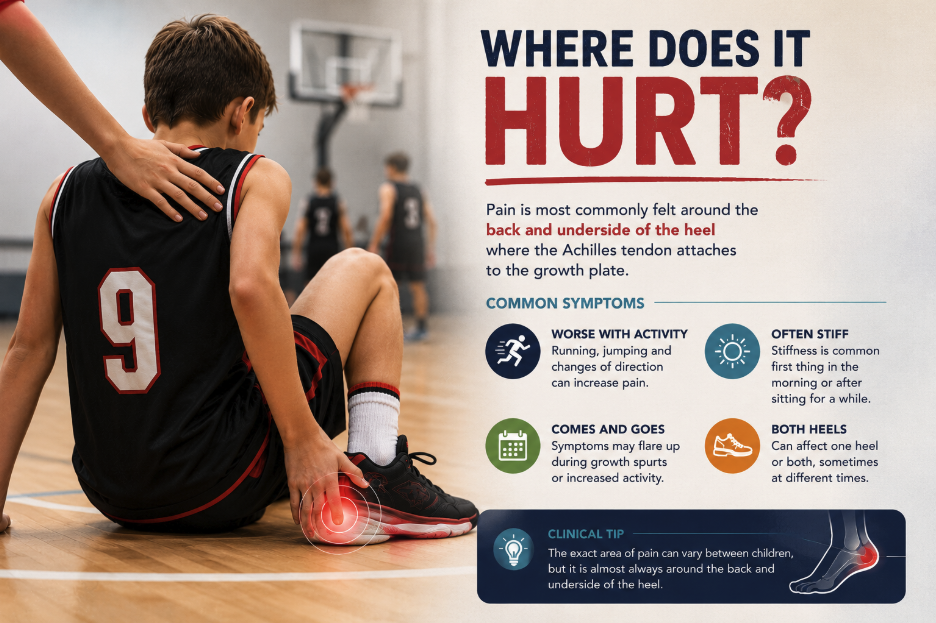
        Where does it hurt?  Heel Pain?

        Helping your Child Stay Active

         One of the first questions almost every parent asks is:

        “Do they have to stop playing sport?”

        Fortunately, the answer is not usually.

        The aim isn’t to wrap children in cotton wool or stop them doing the activities they love. Instead, it’s to help them remain as active as possible while allowing the irritated growth plate time to settle.

        Every child is different.

        A representative basketballer training four nights a week places very different demands on their body compared with a child who enjoys one game of football each weekend. The right plan depends on your child’s symptoms, their sporting commitments and, most importantly, how they’re responding.

        Listen to the Symptoms

        If there’s one message I’d like every parent to take away from this guide, it’s this:

        Let your child’s symptoms guide the plan.

        Children don’t usually need complete rest.

        At the same time, continually pushing through increasing pain isn’t likely to help either.

        Most of the time, the answer lies somewhere in the middle.

        That might mean reducing training for a few weeks, sitting out one session while still playing on the weekend, limiting extra practice at home, or temporarily modifying drills that involve large amounts of running and jumping.

        The goal isn’t to avoid activity altogether.

        It’s to reduce the load enough for the heel to settle before gradually increasing activity again.

        One of the questions I’ll often ask at a review appointment is:

        “Is your child coping better with the same amount of activity than they were two weeks ago?”

        If the answer is yes, that’s usually a good sign they’re adapting well and may be ready to slowly progress their activity again.

        Small Changes Can Make a Big Difference

        Sometimes relatively simple changes can make sport much more comfortable.

        Depending on your child’s presentation, we might discuss:

        • supportive footwear with good cushioning
        • whether they’ve recently outgrown their shoes
        • heel cups or heel lifts
        • temporary taping
        • gentle calf stretching where appropriate
        • progressive strengthening exercises as symptoms improve

        None of these strategies are designed to “fix” the growth plate itself.

        Instead, they’re aimed at reducing the stress passing through the heel while allowing your child to remain involved in their normal activities wherever possible.

        Can Hands-On Treatment Help?

        Parents often ask whether massage or hands-on treatment has a role.

        Current research specifically investigating manual therapy for Sever’s disease is limited, so we can’t confidently say that it changes the natural course of the condition.

        However, that’s only part of the story.

        In my own clinical experience, many children report worthwhile symptomatic relief following supportive treatments such as calf muscle massage, gentle mobilisation of the foot and ankle, taping and other osteopathic techniques.

        These treatments aren’t intended to change the growth plate itself.

        Rather, they may help reduce discomfort, improve movement and make day-to-day activities more comfortable while the condition runs its natural course.

        As our understanding of children’s musculoskeletal conditions continues to evolve, I’m hopeful we’ll continue to see more high-quality research exploring the role manual therapy may play alongside activity modification, exercise and other conservative treatments.

        What About Pain Relief?

        It’s a question almost every parent asks.

        Simple pain-relieving or anti-inflammatory medications may have a role in helping some children remain comfortable, particularly during periods when symptoms are more noticeable.

        Whether medication is appropriate depends on your child’s age, medical history and individual circumstances.

        If you’re considering pain relief, I’d encourage you to speak with your GP or pharmacist. They can advise whether medication is appropriate and how it should be used safely.

        It’s also worth remembering that medication helps manage symptoms—it doesn’t remove the reason the heel has become irritated.

        Even if your child feels more comfortable, it’s still important to listen to what the heel is telling you and adjust activity if symptoms continue to increase.

        Returning to Sport

        One of the most rewarding parts of treating Sever’s disease is watching children regain the confidence to enjoy their sport again.

        Returning to sport is rarely an all-or-nothing decision.

        As symptoms improve, activity is gradually increased. Some weeks will be better than others, particularly during periods of rapid growth, and occasional flare-ups are completely normal.

        A temporary increase in pain doesn’t necessarily mean your child has caused more damage.

        More often, it’s simply useful feedback that the heel has been asked to do a little more than it was ready for.

        With patience, sensible activity modification and an individualised plan, the vast majority of children return to unrestricted sport and leave this temporary stage of growth behind.

        My Clinical Tip

        Children who love their sport don’t simply need to be told to stop.

        They need a plan.

        A good management plan allows them to remain involved where possible, understand what their symptoms are telling them and gradually build back to full participation with confidence.
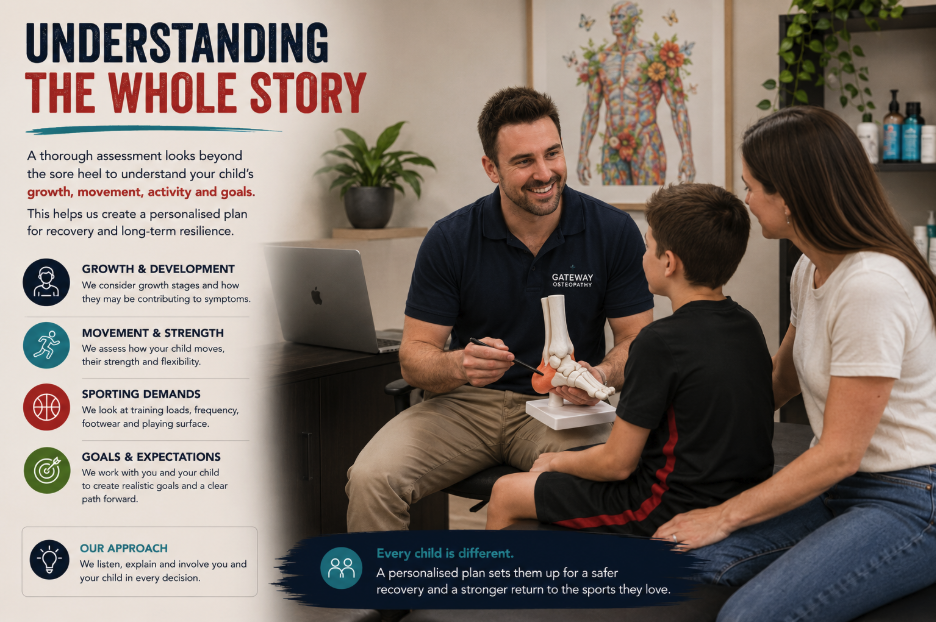
        Understanding Heel Pain - Severs Disease.

        How can and Osteopath Help?


        By the time many families come to see me, they’ve often already tried a few things.

        They may have rested from sport for a week or two, bought a new pair of basketball shoes, tried stretching the calf muscles, searched online for answers or simply hoped the pain would settle on its own.

        Sometimes those strategies are enough.

        Other times, parents are left wondering whether they’re managing the condition appropriately, whether their child is doing too much or too little, or whether they’re missing something more serious.

        That’s where a thorough assessment can help.

        A consultation isn’t just about treating a sore heel.

        It’s about understanding why your child has developed symptoms and helping your family confidently navigate the weeks or months ahead.

        Every child is different.

        Some children simply need reassurance that they’re dealing with a common growth-related condition.

        Others benefit from guidance around modifying training loads, progressing back to sport, selecting appropriate exercises or making simple changes to footwear.

        Occasionally, an assessment suggests the presentation isn’t typical of Sever’s disease at all, and further investigation or referral is the most appropriate next step.

        One of the things I enjoy most about treating children is taking the time to explain what’s happening in language that both parents and children can understand.

        When children understand why they’re being asked to make temporary changes, they’re often much more willing to take ownership of their recovery.

        As a parent myself, I know my own children don’t always listen to me about health, even when I’m convinced I’m giving excellent advice.

        Sometimes hearing exactly the same explanation from someone outside the family is enough for it to click.

        It’s amazing how often a child leaves the consultation repeating back to Mum or Dad the very advice they’ve been hearing at home for the past two weeks.

        Sometimes they simply need to hear it from someone different.

        That conversation can be incredibly valuable.

        It often helps children understand that modifying their activity for a short period isn’t a punishment. It’s simply part of helping them get back to doing the things they enjoy.

        Depending on your child’s individual presentation, your management plan may include:

        • education about Sever’s disease and what to expect
        • guidance around activity modification and returning to sport
        • advice regarding footwear and heel cups where appropriate
        • calf stretching and strengthening exercises
        • supportive manual therapy, including calf muscle massage, gentle mobilisation of the foot and ankle, or taping where indicated
        • communication with your GP or other healthcare professionals if further investigation is required

        Parents often ask me whether hands-on treatment actually helps.

        The honest answer is that the published research specifically investigating manual therapy for Sever’s disease remains limited.

        However, in my own clinical experience, many children report worthwhile symptomatic relief from supportive treatments when they’re combined with sensible activity modification, education and an appropriate exercise program.

        I’m hopeful we’ll continue to see more high-quality research in this area over the coming years, helping us better understand where manual therapy may fit within the overall management of this common childhood condition.

        Perhaps the most rewarding part of caring for children with Sever’s disease is seeing their confidence return.

        Not simply because their heel hurts less, but because they understand what’s happening, they’re no longer worried about causing damage and they have a clear plan for getting back to the sport they love.

        My Clinical Tip

        One of the nicest compliments I receive from parents isn’t, “The treatment worked.”

        It’s when they say,

        “We finally understand what’s been going on.”

        Once families understand the condition and have a sensible plan, managing Sever’s disease often becomes far less stressful for both the child and their parents.

        .

        Frequently Asked Questions.

        Will my child grow out of Sever’s disease?

        Yes.

        The outlook for children with Sever’s disease is excellent. The condition is associated with the growing heel, and symptoms usually settle once the growth plate matures. While the condition can be frustrating during the growing years, it does not permanently damage the heel.

        Can my child still play basketball or other sports?

        In many cases, yes.

        The answer depends on your child’s symptoms rather than the name of the condition.

        Many children are able to continue participating with temporary modifications to their training or activity levels. Others may need a short period of reduced loading before gradually increasing their activity again.

        The goal isn’t necessarily to stop sport altogether. It’s to help your child remain as active as possible while respecting what their heel is telling them.

        Should my child play through pain?

        Not usually.

        Mild discomfort isn’t necessarily harmful, but continually pushing through increasing pain is rarely helpful.

        As a general guide, symptoms should settle reasonably quickly after activity and not continue worsening over time.

        If your child is limping significantly, avoiding weight-bearing or struggling with everyday activities, it’s usually sensible to reduce activity and seek an assessment.

        Does my child need an X-ray?

        Usually not.

        Sever’s disease is most commonly diagnosed from your child’s history and a physical examination.

        However, if the symptoms aren’t following the expected pattern or another condition needs to be ruled out, imaging or referral may be appropriate.

        Will orthotics or heel cups fix the problem?

        Not necessarily.

        Some children find heel cups or temporary heel lifts very helpful in reducing symptoms, while others notice little difference.

        These devices don’t “fix” the growth plate, but they may improve comfort and form one part of an overall management plan.

        Orthotics are not required for every child with Sever’s disease. Whether they’re appropriate depends on the individual child and the findings of their assessment.

        Does massage or hands-on treatment help?

        Current published research specifically investigating manual therapy for Sever’s disease is limited.

        However, in my clinical experience, some children report worthwhile symptomatic relief from treatments such as calf muscle massage, gentle mobilisation of the foot and ankle, and other supportive osteopathic techniques when combined with sensible activity modification and an appropriate exercise program.

        Should we ice the heel?

        Some children find that applying ice after sport provides temporary relief from discomfort.

        Ice doesn’t change the underlying growth process, but it may help manage symptoms following periods of increased activity.

        As with many supportive measures, the aim is to help your child remain comfortable while the irritated growth plate settles naturally over time.

        Is stretching helpful?

        Sometimes.

        If calf muscle tightness is contributing to your child’s symptoms, gentle stretching may be beneficial.

        The key is making sure the exercises are appropriate for your child and introduced at the right stage of their recovery.

        Is Sever’s disease caused by growing too quickly?

        Not directly.

        Growth itself isn’t the problem.

        Rather, Sever’s disease appears to develop when the growing heel is exposed to repeated loading during a period of rapid growth. That’s one of the reasons symptoms are often seen in active children who enjoy sports involving running and jumping.

        When should I seek professional advice?

        It’s worth arranging an assessment if your child’s heel pain is:

        • affecting their ability to enjoy sport
        • causing them to limp
        • continuing to return despite rest
        • making everyday activities uncomfortable
        • not following the typical pattern you’ve read about here
        • causing you to wonder whether something else could be going on

        Sometimes the greatest benefit of an assessment isn’t simply receiving a diagnosis.

        It’s understanding what’s happening, knowing what to expect and leaving with a clear plan for helping your child stay active.

        My Clinical Tip

        One of the questions parents often ask at the end of a consultation is,

        “When will they be back to normal?”

        Unfortunately, there’s no exact timeline because every child grows differently.

        Rather than focusing on a specific date, I encourage families to look for gradual progress. If your child is becoming more comfortable with the same amount of activity than they were a few weeks ago, you’re usually heading in the right direction

        .

        .
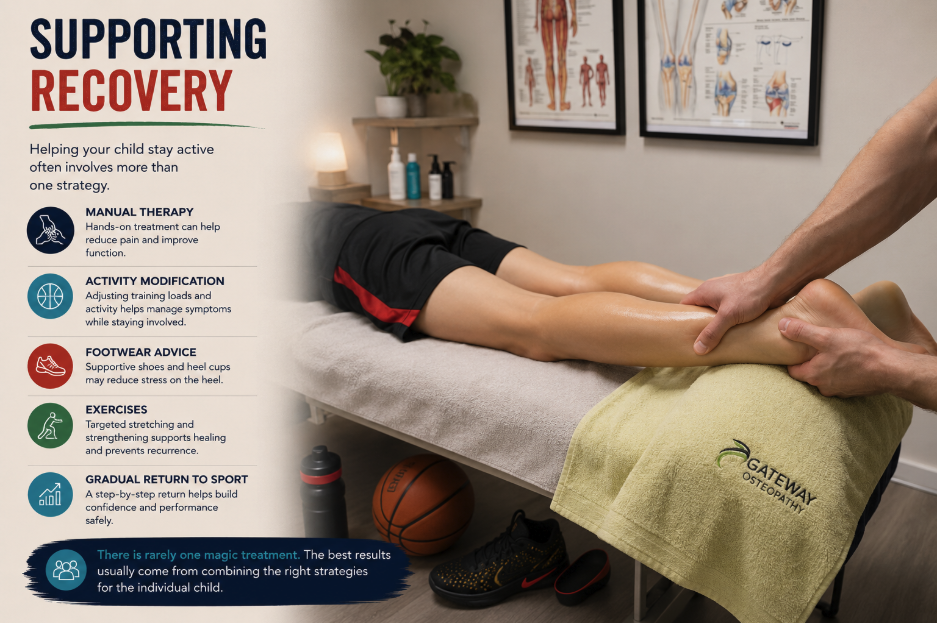
        Supportive Recovery Severs Disease
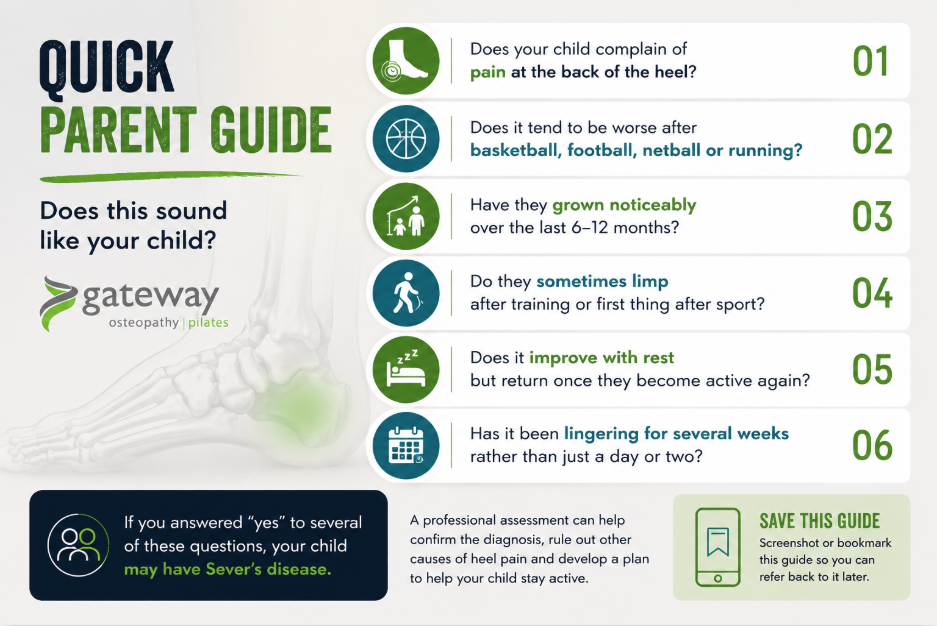
        Quick Parent Guide to Heel Pain

        Final Thoughts.

        If there’s one message I’d like you to take away from this guide, it’s that Sever’s disease is usually a temporary stage of growth, not a permanent injury.

        Although it can be painful and frustrating, particularly for children who love their sport, the outlook is generally very good. With a sensible approach to managing activity, most children continue to enjoy the activities they love and make an excellent recovery as they finish growing.

        For many families, the greatest challenge isn’t the diagnosis itself. It’s understanding why the pain comes and goes, knowing how much activity is appropriate, and feeling confident that they’re making the right decisions.

        That’s why education is such an important part of management.

        Once parents understand what’s happening and children understand why temporary changes may be needed, the whole process often becomes far less stressful.

        Every child is different. Some recover quickly, while others experience occasional flare-ups during periods of rapid growth or increased sporting activity. That doesn’t necessarily mean anything has gone wrong. More often, it simply means the management plan needs to be adjusted to suit where your child is in their growth journey.

        As both an osteopath and a parent, I appreciate how difficult it can be to tell a young athlete they may need to slow down, even for a short time. The good news is that, with the right advice and a clear plan, most children don’t have to choose between doing nothing and pushing through pain.

        They simply need guidance to help them navigate this temporary stage of growth.

        If your child has persistent heel pain or you’re unsure whether their symptoms are consistent with Sever’s disease, I’d encourage you to seek a professional assessment. Sometimes the greatest reassurance comes not from receiving treatment, but from understanding what’s happening and having confidence in the plan moving forward.
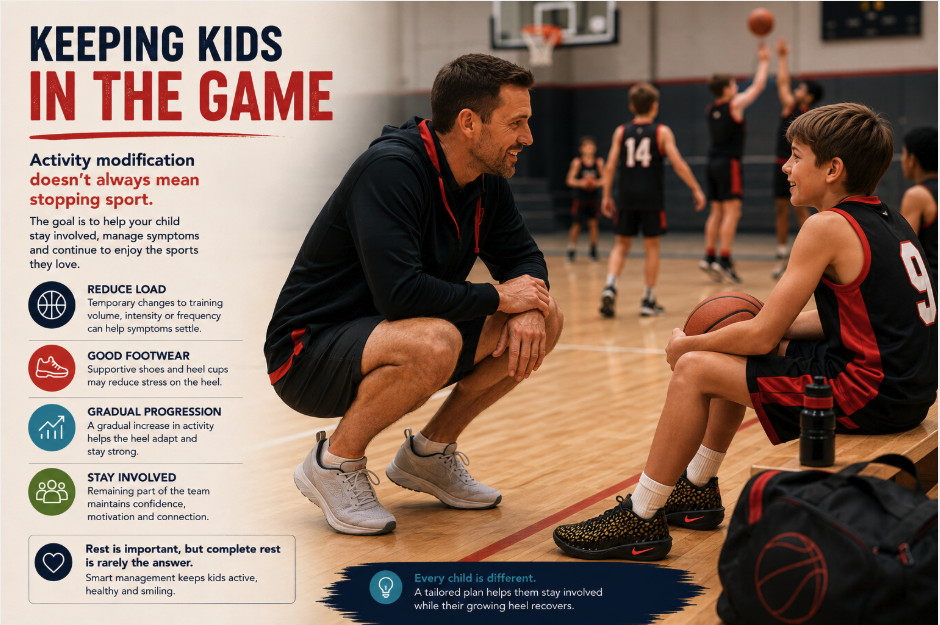
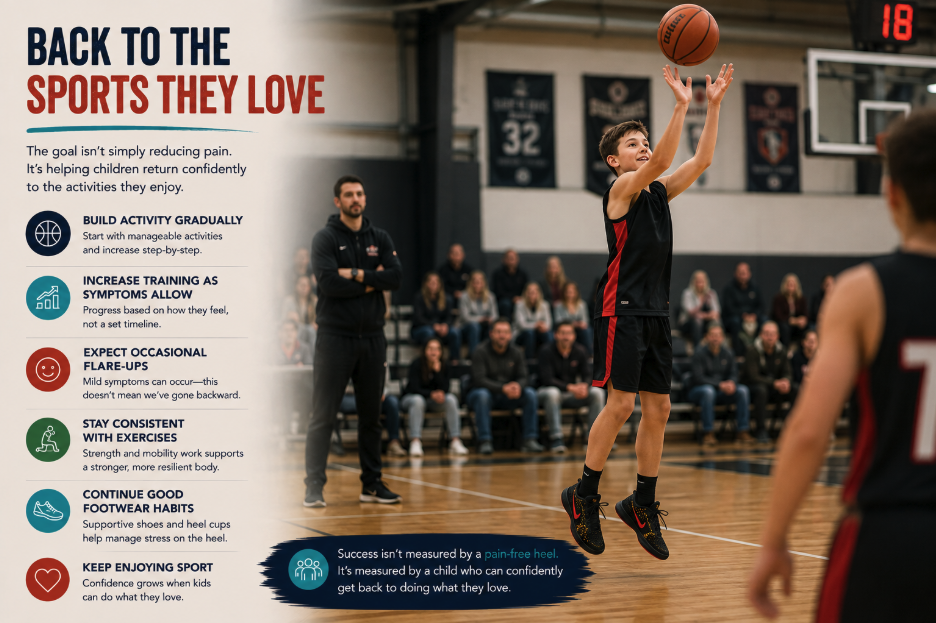
        Keeping in the game
        Back to the sports they love

        Ready to investigate that heel pain?

        Achilles Tendinopathy Treatment in Eltham

        Achilles Tendinopathy Treatment in Eltham

        Achilles Tendinopathy Treatment in Eltham

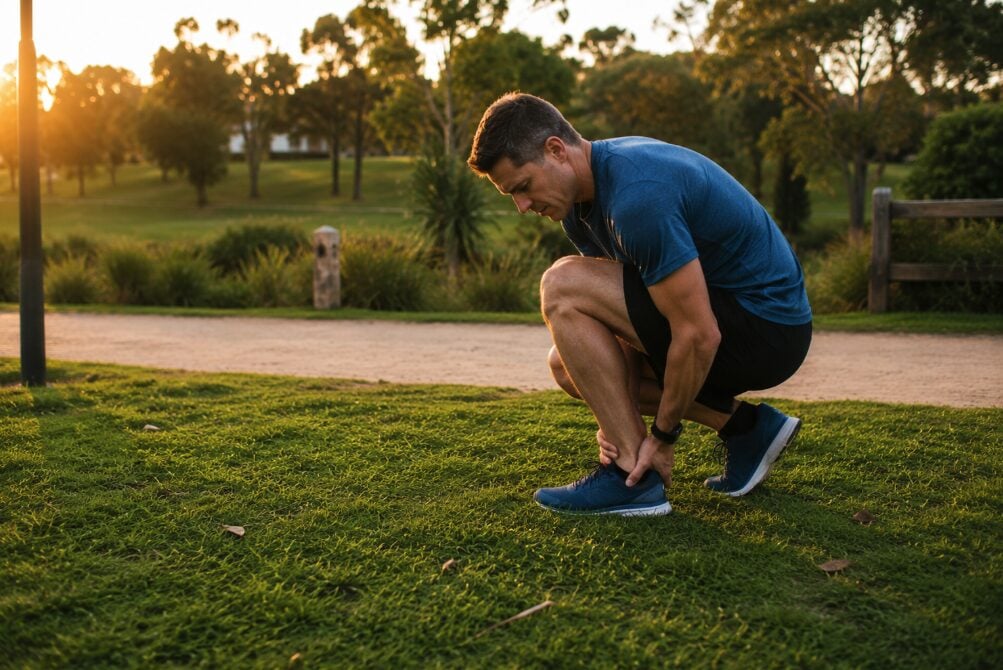
        Achilles pain stopping you from walking, running or playing sport?

        Achilles tendon pain can be frustrating. For some people it begins as a slight stiffness when getting out of bed in the morning. Others first notice it after a run, a long walk or a game of sport. In many cases, the pain gradually worsens until everyday activities such as climbing stairs, walking uphill or simply getting through a day’s work become uncomfortable.

        One of the most confusing aspects of Achilles tendinopathy is that it often doesn’t seem to follow the rules. The tendon may feel stiff first thing in the morning, loosen up after a few minutes of walking, then become sore again later in the day. Some people can even complete a run reasonably comfortably, only to struggle getting out of bed the following morning.

        At Gateway Osteopathy, we regularly assess and treat Achilles tendon pain in people from Eltham, Montmorency, Greensborough, Diamond Creek and the surrounding areas. We see everyone from recreational runners and competitive athletes to tradies, teachers, busy parents and retirees who simply want to keep enjoying an active lifestyle.

        Our aim isn’t simply to reduce your pain.

        We want to understand why your Achilles tendon became overloaded in the first place, identify the factors contributing to the problem and help you safely return to the activities that matter most to you.

        Treatment may include education, activity modification, progressive strengthening, manual therapy, dry needling and shockwave therapy where appropriate. Every rehabilitation program is tailored to the individual rather than following a one-size-fits-all approach.


        What is Achilles Tendinopathy?

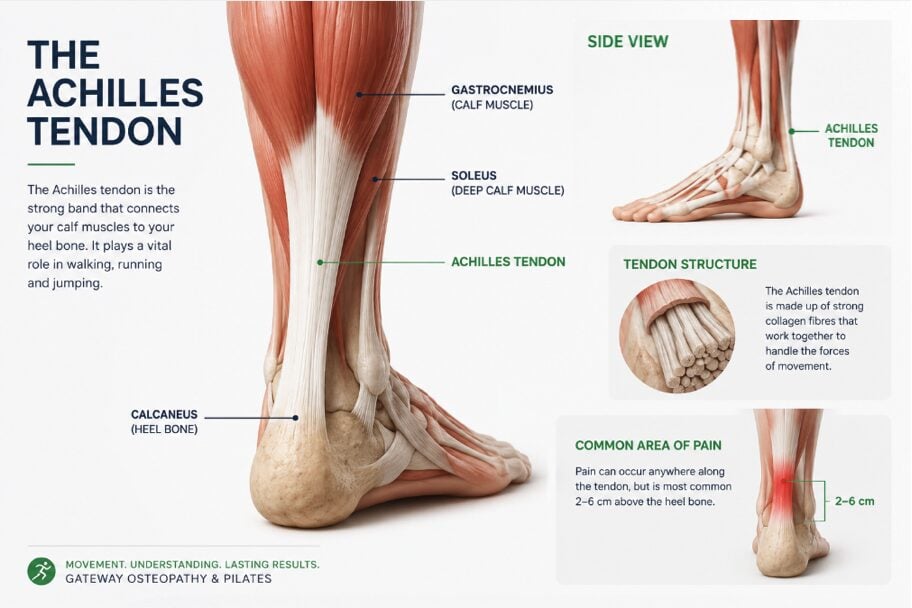
        The Achilles tendon is the largest and strongest tendon in the human body.

        It joins your calf muscles to your heel bone and is responsible for transferring enormous amounts of force every time you walk, climb stairs, run or jump. Despite being remarkably strong, the Achilles tendon is constantly adapting to the demands placed upon it.

        When the tendon is exposed to regular, appropriate loading it generally becomes stronger and more resilient.

        When the demands placed upon it exceed what it is currently capable of tolerating, the tendon can become painful.

        Years ago this condition was commonly referred to as Achilles tendinitis, suggesting inflammation was the primary cause of the pain.

        Our understanding has changed considerably over the past two decades.

        While inflammation may play a role in the early stages of an injury, many ongoing Achilles problems involve changes within the tendon itself rather than persistent inflammation. This is why healthcare professionals now more commonly use the term Achilles tendinopathy.

        Although that terminology has changed, the important message for patients remains reassuring.

        An Achilles tendon is living tissue. It has the ability to adapt and become stronger again when it is exposed to the right type and amount of loading.

        For most people, successful treatment isn’t about simply resting the tendon. It’s about gradually helping it regain its ability to cope with the demands of everyday life, work and sport.


        What Does Achilles Tendinopathy Feel Like?

        Symptoms vary from person to person, but commonly include:

        • Pain or stiffness in the Achilles tendon, particularly first thing in the morning.
        • Pain when beginning to walk after sitting for a period of time.
        • Tenderness when pressing on the tendon.
        • Pain during or after running, walking or sport.
        • Discomfort climbing stairs or walking uphill.
        • Thickening of the tendon.
        • Reduced confidence when pushing off the affected leg.
        • Symptoms that settle once you’ve been moving but return later in the day or the following morning.

        Morning stiffness is one of the features we pay particular attention to during rehabilitation.

        Many patients tell us they “hobble” to the bathroom when they first get out of bed, only to feel relatively normal ten or fifteen minutes later.

        That temporary improvement doesn’t necessarily mean the tendon has recovered.

        In fact, the level of morning stiffness often provides a better indication of how the tendon is coping than how it feels during activity itself. As rehabilitation progresses, many people notice the morning stiffness gradually becomes less severe and resolves more quickly.


        Why Does Achilles Tendinopathy Develop?

        One of the most common things I hear in the clinic is:

        “I wasn’t doing anything unusual.”

        When we look a little closer, that’s often true.

        Perhaps you realised your train was about to leave and had to sprint along the platform at Eltham, Montmorency, Greensborough or Diamond Creek Station.

        A father spends half an hour kicking the football with his children after months of mostly sitting behind a desk.

        A mum decides it’s finally time to return to basketball after years away from the game.

        Someone commits to getting healthier and starts a Couch to 5K running program.

        None of these activities are unreasonable.

        In many cases, they simply exposed a tendon that had quietly become less tolerant of those loads over time.

        Life has a habit of getting in the way.

        Work becomes busier.

        Children become the priority.

        Exercise becomes less frequent.

        Without us really noticing, months, or sometimes years can pass without regularly exposing the Achilles tendon to the sort of forces it once managed comfortably.

        Then one day we suddenly ask it to sprint, jump, hike or play sport as though nothing has changed.

        The tendon simply isn’t prepared.

        One of the biggest misconceptions is that the event itself caused the problem.

        More often, the event simply revealed a reduction in the tendon’s ability to cope with that load.

        The activity wasn’t unreasonable.

        The tendon simply wasn’t ready for it.


        Midportion vs Insertional Achilles Tendinopathy

        Although both conditions affect the Achilles tendon, the location of your symptoms can influence your rehabilitation.

        Midportion Achilles tendinopathy is the most common presentation. Pain is typically felt around two to six centimetres above the heel bone, where changes within the tendon most commonly occur.

        Insertional Achilles tendinopathy affects the point where the tendon attaches to the heel bone. This type of Achilles pain may be aggravated by activities that place the ankle into greater dorsiflexion, such as walking uphill or allowing the heel to drop below the level of a step during exercise.

        While the underlying principles of rehabilitation remain similar, the exercises and the way they are progressed may differ depending on which part of the tendon is involved.

        For this reason, an accurate assessment is important before beginning a strengthening program.


        What My Years in Practice Has Taught Me About Achilles Pain

        One thing I’ve noticed after treating Achilles tendon problems for many years is that patients often remember the moment the pain started, but they rarely think about the months leading up to it.

        They’ll tell me about sprinting for the train, a long walk on holidays, a game of social tennis or kicking the football with the kids.

        Those moments are easy to remember because that’s when the pain became obvious.

        What often goes unnoticed is that the tendon may have been gradually losing its conditioning long before that day arrived.

        Our bodies are remarkably good at adapting when we continue asking them to do something.

        They’re equally good at adapting when we stop.

        As our activity levels change through work, family commitments, injury or simply getting older, the demands placed on the Achilles tendon often reduce as well. Over time, the tendon becomes less accustomed to handling higher loads.

        Then one day we ask it to perform as though nothing has changed.

        In many cases, the activity itself wasn’t excessive.

        It simply exceeded what the tendon was prepared for at that point in time.

        I think this is one of the most important concepts for people to understand because it also explains why recovery isn’t usually about finding a single treatment that “fixes” the tendon.

        Successful rehabilitation is about gradually rebuilding the tendon’s ability to tolerate the activities that are important to you, whether that’s walking the dog around Eltham, returning to running, getting back onto the football field or simply being able to keep up with your children or grandchildren.

        When people understand why the problem developed, they’re often much more confident throughout the rehabilitation process.

        Because recovery isn’t simply about reducing pain.

        It’s about rebuilding confidence in your tendon, restoring its strength and helping it cope with the demands of the life you want to live.

            Achilles Tendon Pain Anatomy

            .

            How We Assess Achilles Tendinopathy

            Every Achilles tendon problem is slightly different.

            Two people may have pain in a similar location, but the reason the tendon became overloaded, how long it has been present and the best rehabilitation strategy can vary considerably.

            That’s why treatment should always begin with a thorough assessment rather than simply selecting exercises from a standard program.

            During your consultation we’ll discuss questions such as:

            • When did the pain first begin?
            • Did it develop gradually or after a particular activity?
            • Is the pain worse first thing in the morning?
            • Has your training or activity level changed recently?
            • What activities are you hoping to return to?
            • Have you had previous tendon injuries?

            We then examine the tendon itself, looking at:

            • The location of your symptoms.
            • Areas of tenderness.
            • Thickening of the tendon.
            • Calf strength.
            • Single leg calf raises.
            • Walking and running mechanics where appropriate.
            • Ankle movement and calf flexibility.
            • Factors elsewhere in the kinetic chain that may be contributing to increased load through the Achilles tendon.

            Just as importantly, we’ll also discuss your goals.

            Someone hoping to walk comfortably around the neighbourhood has very different rehabilitation requirements to someone preparing for a marathon or returning to competitive football.

            Understanding what you want to achieve helps guide the rehabilitation process.


            Do I Need a Scan?

            One of the most common questions we hear is:

            “Do I need an ultrasound or MRI?”

            The answer is not always.

            Achilles tendinopathy can often be diagnosed from a detailed history and physical examination without requiring imaging.

            In fact, research has shown that many people have changes within their Achilles tendon on ultrasound or MRI despite having little or no pain at all.

            Likewise, someone with significant pain may only have relatively minor changes visible on imaging.

            For this reason, scans should always be interpreted alongside your symptoms and clinical examination rather than in isolation.

            If your presentation is straightforward, imaging may not change the way your condition is managed.

            However, a scan may be recommended if:

            • The diagnosis is unclear.
            • We suspect a partial tear or rupture.
            • Symptoms are not progressing as expected.
            • Surgery is being considered.
            • There are other concerns that require further investigation.

            When imaging is required, an ultrasound is often an excellent first investigation. It provides good visualisation of the tendon and can identify tendon thickening, degeneration and partial tears.

            MRI may occasionally be recommended in more complex cases where additional detail is required.

            One of the principles we strongly believe in at Gateway Osteopathy is simple:

            We treat people – not scans.

            Your symptoms, your examination findings and your goals will always guide treatment more than the appearance of your MRI or ultrasound.


            How Is Achilles Tendinopathy Treated?

            Modern treatment for Achilles tendinopathy has changed considerably over the past twenty years.

            While rest was once commonly recommended, we now know that prolonged rest alone rarely restores a tendon’s ability to tolerate everyday activities.

            Instead, treatment focuses on helping the tendon gradually adapt to load again while avoiding activities that continue to excessively aggravate it.

            Your treatment plan may include a combination of:

            • Education about your condition.
            • Temporary modification of aggravating activities.
            • Progressive strengthening exercises.
            • Manual therapy where appropriate.
            • Dry needling for associated muscle tightness where appropriate.
            • Shockwave therapy in selected cases.
            • Advice regarding footwear and training progression.
            • Guidance on returning to work, running or sport.

            No single treatment works for every person.

            Instead, we combine the treatments most appropriate to your individual presentation while monitoring your progress over time.

            Recovery is rarely about finding a miracle treatment.

            More often, it’s about consistently making the right decisions over a period of weeks and months while gradually rebuilding the tendon’s ability to tolerate increasing demands.


            Shockwave Therapy for Achilles Tendinopathy

            Shockwave therapy has become an increasingly recognised treatment option for persistent Achilles tendinopathy.

            It involves delivering acoustic pressure waves into the affected tissues and is thought to stimulate biological processes involved in tendon healing and pain reduction.

            Current research suggests that shockwave therapy may improve pain and function in selected patients, particularly when symptoms have persisted despite an appropriate rehabilitation program.

            Like all treatments, however, shockwave therapy isn’t a magic cure.

            We don’t recommend it simply because someone has Achilles pain.

            Instead, we consider whether it is likely to add value alongside an appropriate strengthening program and your overall rehabilitation plan.

            At Gateway Osteopathy, shockwave therapy is used as one component of a comprehensive treatment approach rather than a stand-alone solution.

            For many patients, the combination of education, progressive strengthening and carefully selected adjunctive treatments provides the best opportunity for long-term improvement.


            Returning to Running and Sport

            One of the biggest mistakes people make is assuming that because the pain has settled, the tendon has completely recovered.

            Pain often improves before the tendon has fully regained its ability to cope with higher loads.

            Returning too quickly can result in symptoms flaring again, creating the impression that the injury has “come back.”

            A successful return to running or sport is usually gradual.

            This often involves progressively increasing walking, jogging, running, jumping or sport-specific activities while monitoring how the tendon responds over the following 24 hours.

            Some mild discomfort during rehabilitation isn’t necessarily a sign that damage is occurring.

            In many cases, the more important question is:

            How does the tendon feel the next morning?

            If symptoms settle quickly and morning stiffness remains stable or continues improving, the tendon is often tolerating the rehabilitation well.

            If pain progressively worsens or morning stiffness increases significantly, it may simply indicate that the tendon wasn’t quite ready for that amount of loading yet.

            Learning to interpret these responses is an important part of successful rehabilitation and something we work closely with our patients to understand.


            How Long Does Recovery Take?

            One of the first questions most people ask is:

            “How long before it gets better?”

            Unfortunately, there isn’t a simple answer.

            Recovery depends on a number of factors, including:

            • How long symptoms have been present.
            • The severity of the tendinopathy.
            • Your overall health.
            • Previous activity levels.
            • How consistently rehabilitation is followed.
            • The physical demands of your work or sport.

            Some people notice meaningful improvement within a few weeks.

            For others, particularly if symptoms have been present for many months, rehabilitation may take several months.

            That can feel frustrating.

            However, it’s important to remember that tendons generally adapt more slowly than muscles.

            Meaningful improvements usually occur gradually rather than overnight.

            One of the most encouraging things we see in practice is that even longstanding Achilles tendinopathy can often improve significantly when the underlying reasons for the problem are addressed and rehabilitation is progressed appropriately.

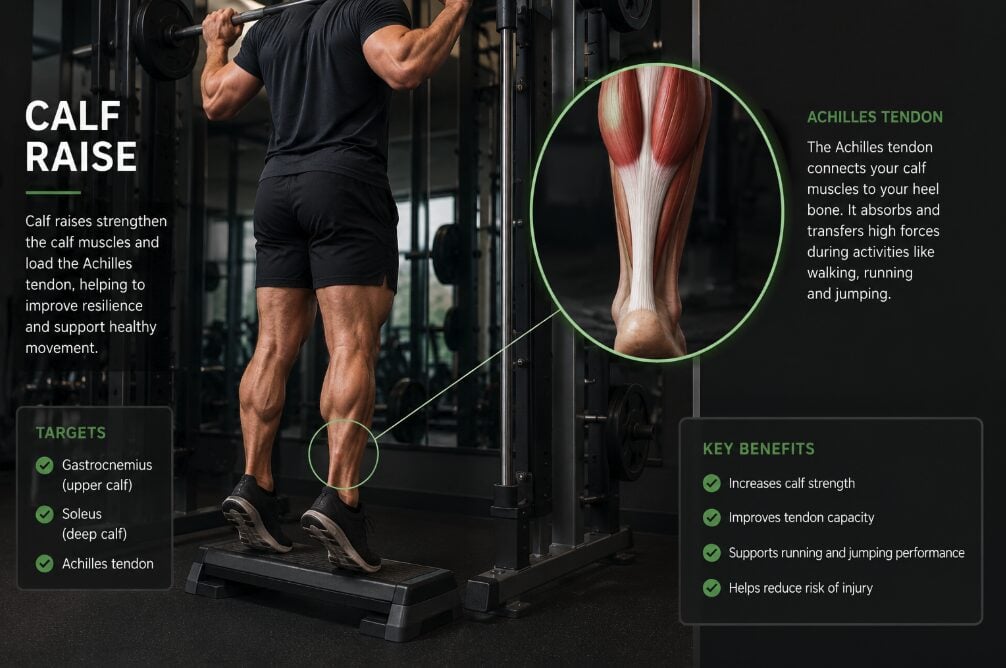
            Smith Machine Calf Raises

            Why Does Achilles Tendinopathy Keep Coming Back?

            Perhaps the most frustrating part of Achilles tendinopathy isn’t the pain itself.

            It’s getting better, returning to your normal activities, then finding the pain gradually creeping back a few weeks or months later.

            Over the years, I’ve noticed that many recurring Achilles problems have one thing in common.

            People often stop rehabilitating the tendon as soon as it starts feeling better.

            That’s completely understandable.

            When you’re no longer limping, the morning stiffness has settled and you’re back walking comfortably, it’s natural to assume the tendon has recovered.

            Unfortunately, pain often settles before the tendon has fully regained its ability to cope with higher levels of activity.

            If training loads increase more quickly than the tendon has adapted, symptoms can return.

            Sometimes the trigger is obvious.

            Returning to running too quickly.

            A hiking holiday.

            A busy week at work involving more walking than usual.

            Starting preseason training after months away from sport.

            Other times there isn’t an obvious trigger at all.

            Life simply becomes busy again.

            Strength exercises become less frequent.

            Activity gradually changes.

            Over time, the tendon’s ability to cope with load reduces once again.

            One of the goals of rehabilitation isn’t simply to reduce your pain today.

            It’s to improve the tendon’s ability to tolerate the activities that are important to you over the long term.

            For many people, maintaining some level of calf strengthening after their symptoms have resolved becomes just as important as the rehabilitation that got them better in the first place.

            Rather than thinking about rehabilitation as something you stop once the pain disappears, it’s often more helpful to think of it as investing in the long-term health of your tendon.


            Frequently Asked Questions

            Should I stop walking if my Achilles hurts?

            Not necessarily.

            Completely avoiding activity is rarely the answer. In many cases, modifying your activity while beginning an appropriate strengthening program is more beneficial than prolonged rest.

            The right balance depends on how irritable your tendon is and what activities are provoking your symptoms.


            Can I keep running?

            Sometimes.

            For some people, reducing running volume or intensity is enough while rehabilitation progresses. Others may need a temporary break from running before gradually returning.

            The decision depends on your symptoms, your goals and how the tendon responds over the following 24 hours.


            Should I stretch my calf muscles?

            Stretching can be helpful in some situations, particularly where reduced ankle mobility or calf tightness is contributing to increased tendon loading.

            However, stretching alone is unlikely to resolve Achilles tendinopathy.

            Progressive strengthening usually forms the foundation of rehabilitation.


            Is Achilles tendinopathy the same as Achilles tendinitis?

            Not quite.

            The term Achilles tendinitis suggests inflammation is the primary problem.

            Current research shows that many persistent Achilles problems involve changes within the tendon itself rather than ongoing inflammation, which is why the term Achilles tendinopathy is now more commonly used.


            Will I need shockwave therapy?

            Not everyone does.

            Shockwave therapy can be a useful treatment option for some people, particularly when symptoms have been present for some time or progress has stalled.

            Like any treatment, it works best when combined with an appropriate rehabilitation program rather than being used on its own.


            Will I need surgery?

            Fortunately, most people with Achilles tendinopathy improve with conservative management.

            Surgery is generally considered only after an appropriate period of well-managed rehabilitation has failed to produce sufficient improvement.


            Can Achilles tendinopathy heal completely?

            Many people return to walking, running and sport without ongoing limitations.

            The key is allowing the tendon enough time to adapt and ensuring rehabilitation continues long enough to rebuild its ability to tolerate higher loads.


            Is morning stiffness normal?

            Yes.

            Morning stiffness is one of the most common features of Achilles tendinopathy.

            During rehabilitation, we’re often less interested in whether you experienced some discomfort and more interested in whether the morning stiffness is gradually becoming less severe over time.


            References

            The recommendations within this article are based on current evidence and contemporary approaches to tendon rehabilitation, including guidance from:

            • Malliaras P, Barton CJ, Reeves ND & Langberg H. Achilles and patellar tendinopathy loading programmes.
            • Silbernagel KG and colleagues – Achilles tendon rehabilitation research.
            • Journal of Orthopaedic & Sports Physical Therapy (JOSPT).
            • British Journal of Sports Medicine (BJSM).
            • National Institute for Health and Care Excellence (NICE) guidance where applicable.
            • Current systematic reviews relating to exercise therapy and extracorporeal shockwave therapy for Achilles tendinopathy.

            Still Struggling With Achilles Pain?

            Whether your Achilles pain has been present for a few weeks or has been frustrating you for months, the good news is that many people improve with an accurate diagnosis and a rehabilitation program that matches their goals and lifestyle.

            At Gateway Osteopathy, we take the time to understand not only where your pain is, but why it developed and what you need your body to be capable of doing again.

            Whether that’s returning to running, keeping up with your children or grandchildren, getting through a day’s work comfortably or preparing for your next sporting event, our aim is to help you return with confidence.

            If you’re experiencing persistent Achilles pain and would like an assessment, we’d be happy to help.

              Ready to Address Your Achilles Pain?

              Tennis Elbow Treatment in Eltham

              Tennis Elbow Treatment in Eltham

              Tennis Elbow Treatment in Eltham

              What is Tennis Elbow?

              Pain on the outside of your elbow making it difficult to grip, lift or even shake someone’s hand?

              Despite its name, tennis elbow is rarely caused by playing tennis. At Gateway Osteopathy in Eltham, we see people from all walks of life develop this condition, including tradespeople, office workers, parents, gym enthusiasts, gardeners and weekend warriors.

              Whether your symptoms started after using tools at work, carrying shopping bags, returning to the gym or simply seemed to develop gradually over time, our osteopaths aim to identify not only what is causing your pain but also why it developed in the first place.

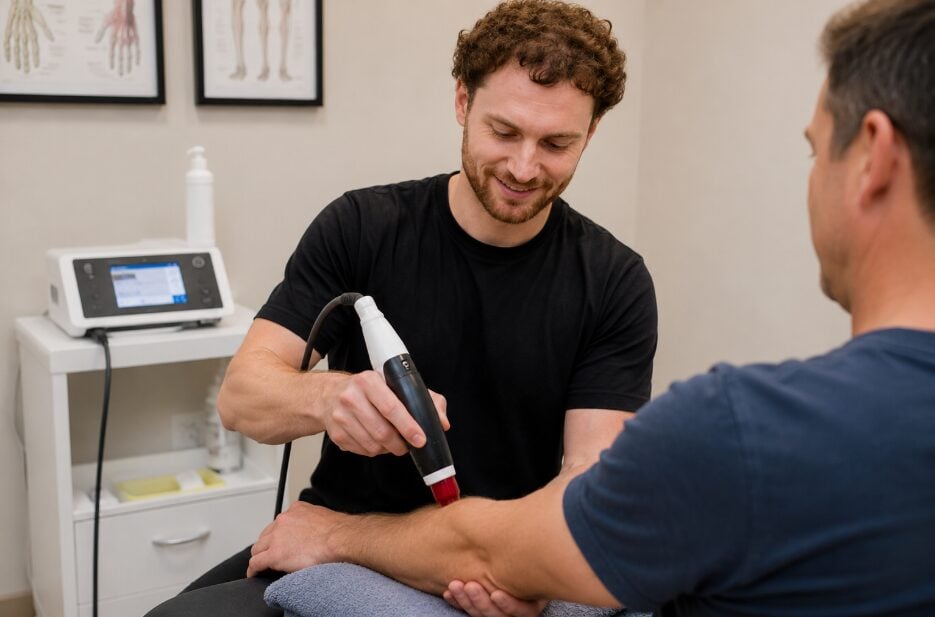
              Depending on your presentation, treatment may include hands-on osteopathic care, progressive rehabilitation exercises, dry needling and radial shockwave therapy where appropriate.

              More on Tennis Elbow?

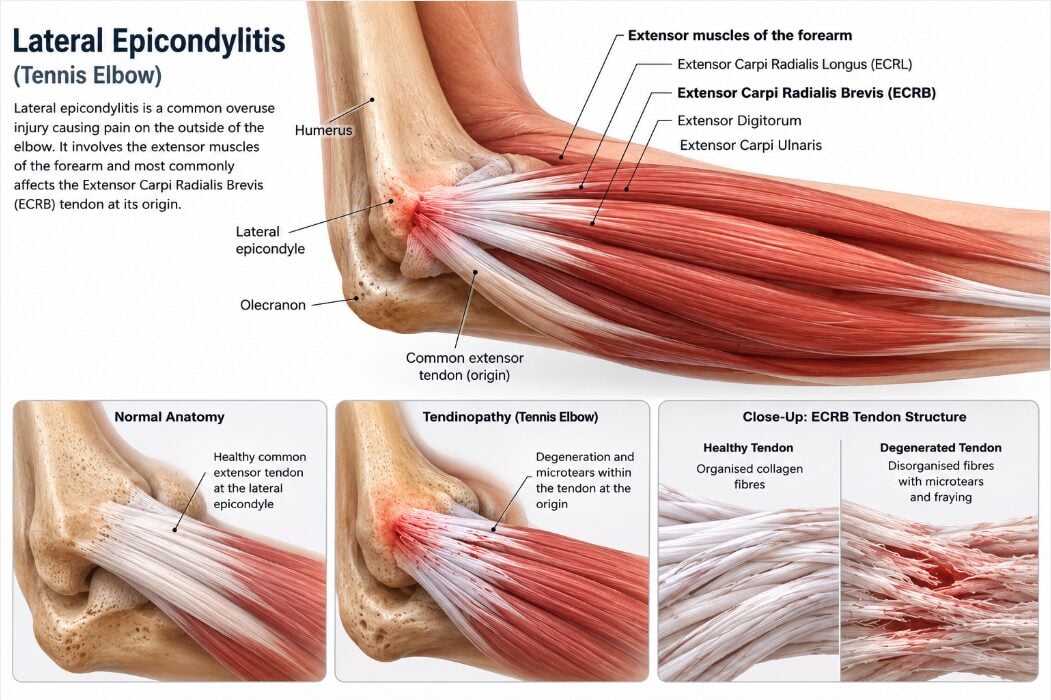
              Tennis elbow, medically known as lateral epicondylitis, is one of the most common causes of pain on the outside of the elbow.

              The condition affects the common extensor tendon, where the muscles responsible for extending your wrist and fingers attach to the lateral epicondyle which is the bony prominence on the outside of the elbow.

              These muscles are heavily involved whenever you grip, lift, carry or use tools. If the tendon is repeatedly exposed to more load than it can comfortably tolerate, it can become painful and lose some of its ability to cope with everyday activities.

              Although the name lateral epicondylitis is still widely recognised, research has shown that long-standing cases often involve changes within the tendon itself rather than ongoing inflammation. Because of this, terms such as lateral epicondylopathy or lateral elbow tendinopathy are becoming increasingly common.


              Tennis Elbow at Gateway.

              .

              What Causes Tennis Elbow?

              Despite the name, most people I treat with tennis elbow have never played tennis.

              Instead, the tendon usually becomes overloaded because it is repeatedly exposed to more force than it can comfortably tolerate.

              Common contributing factors include:

              • Repetitive gripping.
              • Manual work.
              • Weight training.
              • Racquet sports.
              • Gardening.
              • Painting.
              • Computer and mouse use.
              • Sudden increases in activity.
              • Returning to work or sport after a break.

              One thing I’ve learnt over many years in practice is that people often overload the tendon in surprisingly similar ways.


              Christmas Shopping Elbow

              Every year around Christmas I seem to notice an increase in people presenting with tennis elbow. In fact, I sometimes jokingly refer to it as “Christmas Shopping Elbow.”

              Imagine spending several hours walking around the shops carrying multiple heavy shopping bags. As fatigue sets in, your shoulders gradually roll forwards and your posture begins to slump.

              The bags start brushing against the outside of your legs with every step.

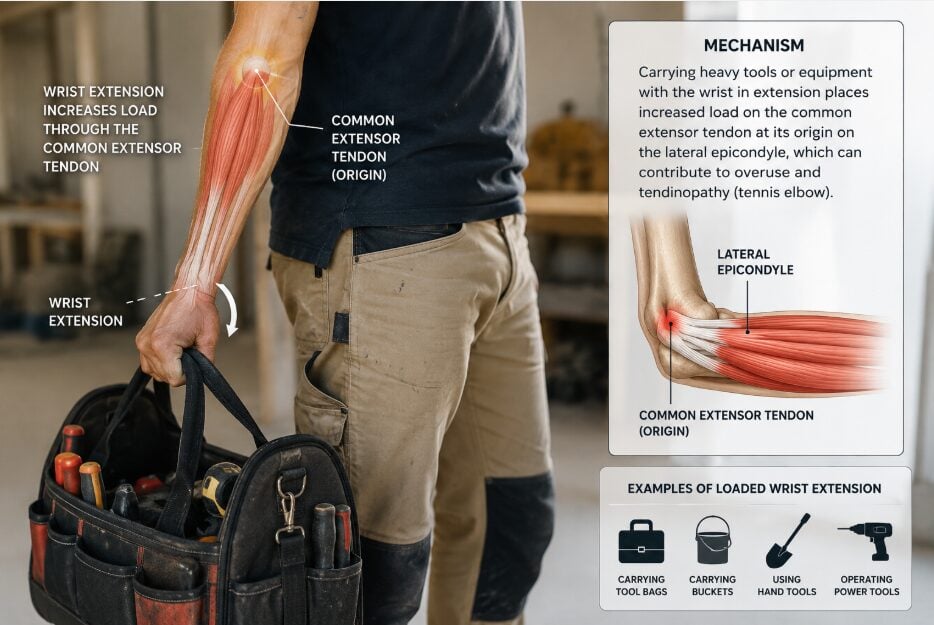
              Rather than standing taller and drawing the shoulders back, many people instinctively extend their wrists to move the bags further away from their body. While it seems like a small adjustment, it significantly increases the load through the common extensor tendon on the outside of the elbow.

              One afternoon of Christmas shopping probably won’t cause a problem on its own, but repeating this pattern over several shopping trips can eventually exceed what the tendon is capable of tolerating.

              Tennis Elbow Tradie

              What Causes Tennis Elbow?

              Despite the name, most people I treat with tennis elbow have never played tennis.

              Instead, the tendon usually becomes overloaded because it is repeatedly exposed to more force than it can comfortably tolerate.

              Common contributing factors include:

              • Repetitive gripping.
              • Manual work.
              • Weight training.
              • Racquet sports.
              • Gardening.
              • Painting.
              • Computer and mouse use.
              • Sudden increases in activity.
              • Returning to work or sport after a break.

              One thing I’ve learnt over many years in practice is that people often overload the tendon in surprisingly similar ways.


              Christmas Shopping Elbow

              Every year around Christmas I seem to notice an increase in people presenting with tennis elbow. In fact, I sometimes jokingly refer to it as “Christmas Shopping Elbow.”

              Imagine spending several hours walking around the shops carrying multiple heavy shopping bags. As fatigue sets in, your shoulders gradually roll forwards and your posture begins to slump.

              The bags start brushing against the outside of your legs with every step.

              Rather than standing taller and drawing the shoulders back, many people instinctively extend their wrists to move the bags further away from their body. While it seems like a small adjustment, it significantly increases the load through the common extensor tendon on the outside of the elbow.

              One afternoon of Christmas shopping probably won’t cause a problem on its own, but repeating this pattern over several shopping trips can eventually exceed what the tendon is capable of tolerating.

              How is Tennis Elbow Treated?

              Treatment depends on how long symptoms have been present, the severity of your pain and the activities contributing to the problem.

              Your treatment plan may include:

              • Education.
              • Activity modification.
              • Progressive strengthening exercises.
              • Tendon loading programs.
              • Hands-on osteopathic treatment.
              • Soft tissue techniques.
              • Joint mobilisation.
              • Dry needling.
              • Taping.
              • Advice regarding work or sporting technique.
              • Radial shockwave therapy where appropriate.

              Our goal isn’t simply to reduce pain. We want to improve the tendon’s ability to tolerate everyday loads so you can confidently return to work, sport and the activities you enjoy.


              Radial Shockwave Therapy for Tennis Elbow

              For people with persistent tennis elbow that has not responded to initial conservative treatment, radial shockwave therapy may be considered as part of a broader rehabilitation program.

              Current research suggests shockwave therapy may help reduce pain and improve function in selected patients, particularly when combined with an appropriate exercise program rather than used in isolation.


              How Long Does Tennis Elbow Take to Heal?

              Recovery varies depending on how long symptoms have been present and the activities contributing to the condition.

              Many people begin noticing improvements within several weeks, while more persistent cases may require several months of progressive rehabilitation.

              Like most tendon conditions, recovery is about more than simply reducing pain. It also involves rebuilding the tendon’s ability to tolerate load.


              Why Does Tennis Elbow Keep Coming Back?

              One of the biggest misconceptions is that once the pain settles, the tendon has fully recovered.

              Pain often improves before the tendon has regained its previous strength and capacity.

              Returning too quickly to heavy lifting, repetitive gripping or sport may simply overload the tendon again.

              Our aim is to help you recover while also addressing the movement patterns, work habits and loading strategies that contributed to the problem in the first place.


              Evidence-Informed Care

              There is no single treatment that works for every person with tennis elbow.

              Current evidence suggests the best outcomes are achieved by combining education, progressive strengthening, activity modification and, where appropriate, additional therapies such as manual therapy, dry needling or radial shockwave therapy.

              At Gateway Osteopathy in Eltham, we combine current evidence with clinical experience to tailor treatment to the individual rather than applying the same approach to everyone.


              Frequently Asked Questions

              Should I completely rest my arm?

              Usually not. While reducing aggravating activities can be helpful, complete rest often reduces the tendon’s capacity. A gradual rehabilitation program is generally more effective.

              Will I need an MRI or ultrasound?

              Most cases can be diagnosed through a thorough clinical examination. Imaging is usually only recommended if another diagnosis is suspected or symptoms are not progressing as expected.

              Does shockwave therapy work?

              Current evidence suggests radial shockwave therapy may help selected patients, particularly when combined with an appropriate rehabilitation program.

              Can osteopathy help tennis elbow?

              Osteopathy aims to reduce pain, improve movement and address contributing factors affecting the elbow, wrist, shoulder and neck while guiding an evidence-informed rehabilitation program.


              References

              Our treatment recommendations are informed by current clinical practice guidelines and peer-reviewed research, including:

              • Coombes BK, Bisset L, Vicenzino B. Management of Lateral Elbow Tendinopathy.
              • Cullinane FL, Boocock MG, Trevelyan FC. Is Eccentric Exercise an Effective Treatment for Lateral Epicondylitis?
              • Stasinopoulos D, Johnson MI. Evidence-Based Physiotherapy Management of Lateral Elbow Tendinopathy.
              • Contemporary research relating to tendon loading, rehabilitation and radial shockwave therapy.

              Ready to Address Your Elbow Pain?

              Plantar Fasciitis Treatment in Eltham

              Plantar Fasciitis Treatment in Eltham

              Plantar Fasciitis Treatment in Eltham

              What is Plantar Fasciitis?

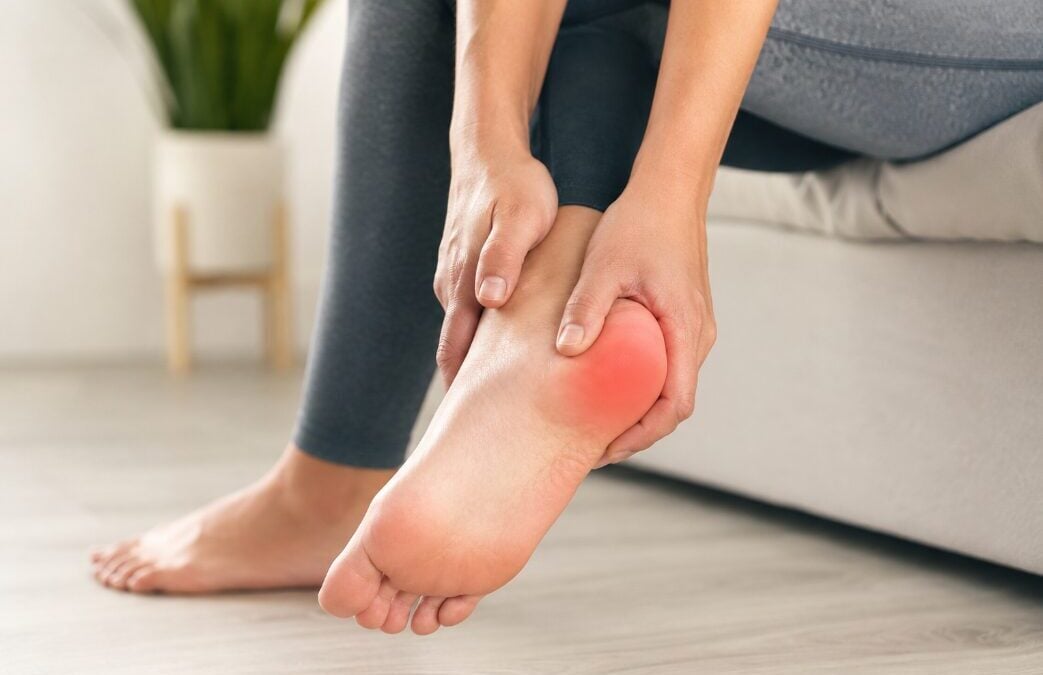
              Heel pain that makes those first few steps in the morning unbearable?

              Plantar fasciitis is one of the most common causes of heel pain. Whether your symptoms started after increasing your walking, running, standing for long hours at work or seemingly out of nowhere, persistent heel pain can make everyday activities frustrating.

              At Gateway Osteopathy in Eltham, our osteopaths take the time to identify the factors contributing to your symptoms and develop an individual treatment plan. Depending on your presentation, treatment may include hands-on osteopathic care, rehabilitation exercises, dry needling and radial shockwave therapy where appropriate.

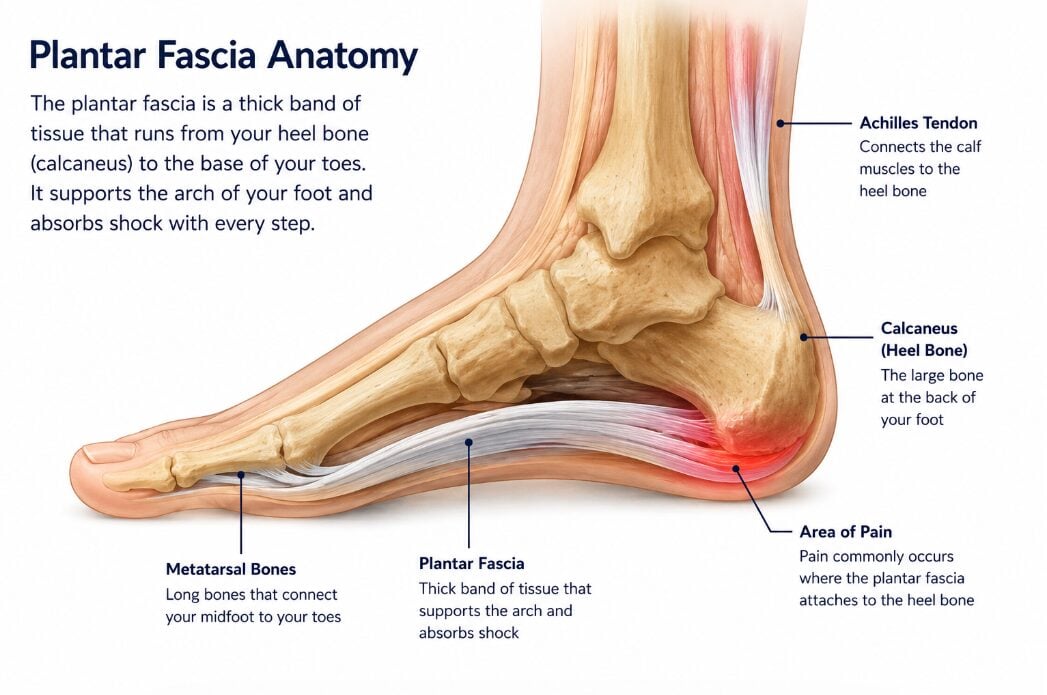
              The plantar fascia is a thick band of connective tissue that runs from the heel bone to the base of your toes. It helps support the arch of your foot and absorbs the forces placed through your foot every time you walk, run or stand.

              Despite the name, plantar fasciitis isn’t always caused by ongoing inflammation. In many people with long-standing heel pain, the tissue has undergone changes associated with repeated loading rather than active inflammation. For this reason, healthcare professionals may also use the term plantar fasciopathy.

              Regardless of the name, the result is the same – pain around the heel that can make everyday activities uncomfortable.


              Anatomy of the Foot and Plantar Fascia

              What Does Plantar Fasciitis Feel Like?

              People describe plantar fasciitis in different ways, but common symptoms include:

              • Sharp pain under or around the heel.
              • Pain that’s worst with the first few steps in the morning.
              • Heel pain after sitting for prolonged periods.
              • Pain that gradually eases as you walk, before returning later in the day.
              • Increased discomfort after long periods of standing or walking.
              • Tenderness when pressing on the inside of the heel.

              Some people notice symptoms developing gradually over weeks or months, while others find the pain starts after a sudden increase in activity or following a change in footwear or work demands.

              Evidence-Informed Care

              At Gateway Osteopathy, we believe patients deserve treatment recommendations based on the best available evidence, combined with clinical experience and an understanding of your individual goals.

              Current research suggests that no single treatment is appropriate for everyone with plantar fasciitis. Instead, the best outcomes are often achieved through an individualised management plan that may include education, exercise rehabilitation, manual therapy, activity modification, footwear advice and, where appropriate, radial shockwave therapy.

              Our osteopaths stay up to date with current clinical practice guidelines and emerging research to help ensure your treatment plan reflects the latest evidence while remaining tailored to your specific needs.


              References

              Our approach to assessing and managing plantar fasciitis is informed by the following clinical practice guidelines and peer-reviewed research.

              Clinical Practice Guideline

              • Martin RL, Davenport TE, Reischl SF, et al. Heel Pain – Plantar Fasciitis: Revision 2023 Clinical Practice Guideline. Journal of Orthopaedic & Sports Physical Therapy. 2023;53(12):CPG1–CPG39.
                https://www.jospt.org/doi/10.2519/jospt.2023.0303

              Key Research

              • Lemont H, Ammirati KM, Usen N. Plantar Fasciitis: A Degenerative Process (Fasciosis) Without Inflammation. Journal of the American Podiatric Medical Association. 2003.
              • Rathleff MS, Molgaard CM, Fredberg U, et al. High-load Strength Training Improves Outcome in Patients with Plantar Fasciitis: A Randomised Controlled Trial. Scandinavian Journal of Medicine & Science in Sports. 2015.
              • Whittaker GA, Munteanu SE, Menz HB, et al. Foot Orthoses for Plantar Heel Pain: A Systematic Review and Meta-analysis. British Journal of Sports Medicine. 2018.
              • Babatunde OO, Legha A, Littlewood C, et al. Comparative Effectiveness of Treatment Options for Plantar Heel Pain: A Systematic Review with Network Meta-analysis. British Journal of Sports Medicine. 2019.

              Ready to Address Your Heel Pain?

              “We understand conditions. We treat people”

              “We understand conditions. We treat people”

              We Understand Conditions. We Treat People.

              By Dr Stuart Robbins (Osteopath)

              People often come to see us carrying a diagnosis.

              It might be a disc bulge, arthritis, tennis elbow, frozen shoulder or migraines. Sometimes they’ve had an MRI, sometimes they’ve seen several health professionals already and occasionally they’ve spent hours researching online trying to work out what’s wrong.

              A diagnosis is important. It helps us understand what may be contributing to someone’s pain and guides many of the decisions we make together. But over the years I’ve realised that a diagnosis is only the starting point.

              The person sitting in front of me is always far more interesting than the words written on a scan report.

              The same diagnosis rarely means the same thing

              One of the things I enjoy most about osteopathy is that no two people are ever quite the same.

              I’ve treated people with almost identical MRI findings who have completely different experiences. One person might continue working, playing golf and looking after their grandchildren with very little discomfort. Another might be struggling to sleep, worried about their future and wondering whether they’ll ever get back to the activities they enjoy.

              The scan might look similar, but the person never is.

              That’s why our consultations are not just about finding the painful structure. We spend time understanding what your symptoms mean to you, what you’re trying to get back to and what concerns you most. That conversation is often just as important as the physical examination.

              Becoming the patient

              Like many health professionals, I’d spent years helping people recover from injuries before I experienced one that significantly changed my own life.

              A lumbar disc injury eventually led to surgery and a long rehabilitation. Suddenly I found myself sitting on the other side of the consultation room.

              I understood what it was like to question every ache, to wonder whether I was improving quickly enough and to have good days followed by frustrating setbacks. I also realised how easy it is for someone to feel that their pain or injury has become their identity.

              That experience didn’t change the science behind what I do, but it changed how I listen.

              I became more interested in understanding what people were worried about rather than simply what hurt. I found myself asking different questions and taking more time to explain why recovery isn’t always a straight line.

              Perhaps most importantly, it reinforced something I’d always believed but hadn’t fully appreciated until I experienced it myself.  People don’t come to an Osteopath because they have an injury or condition, they come because they want their life back.

              Passing that lesson on

              As our team has grown, I’ve found myself repeating the same sentence to our newer practitioners.

              “We understand conditions. We treat people.”

              It’s something I now say regularly when mentoring Isaac and Elodie because I think it’s one of the most important lessons any clinician can learn.

              Early in your career it’s very easy to become fascinated by anatomy, pathology and imaging. Those things matter, and they should. Understanding the human body is fundamental to being a good osteopath.

              But none of that replaces genuinely listening to the person in front of you.

              Looking back, I think this philosophy was probably first introduced to me as a student. I can’t honestly remember exactly where I first heard those words, but they stayed with me. Over the years I was fortunate to work alongside clinicians like Bruce Duncan, who consistently demonstrated that good healthcare begins with understanding people, not simply treating pathology.

              Now I find myself passing that same lesson on to the next generation.

              What this means for our patients

              When someone walks through our doors, we don’t see them as a neck pain, a sore shoulder or a disc bulge.

              We see someone who has work to get back to, children to pick up from school, sport they miss playing or simply a desire to move without constantly thinking about pain.

              Sometimes treatment involves hands-on techniques. Sometimes it’s exercise. Sometimes it’s education or reassurance. Often it’s a combination of all three.

              The specific approach is less important than making sure it’s appropriate for the person sitting in front of us.

              That’s why two people with the same diagnosis may leave with completely different management plans.

              Why this philosophy matters

              Healthcare continues to evolve, and that’s a good thing. We understand far more about pain, rehabilitation and recovery than we did twenty years ago, and we continue to learn every year.

              But despite all those advances, one thing hasn’t changed.

              People still want to feel heard.

              They want someone to explain what’s happening in language they understand. They want honest advice, realistic expectations and a plan that fits their life rather than a textbook.

              That’s the philosophy we’ve tried to build Gateway Osteopathy around.

              Understanding the condition is essential.

              Understanding the person is what allows us to help.


              Ready to Address Your Back Pain?