Heel Pain – Severs Disease
Why does my child’s heel hurt?
Understanding Sever’s Disease (Calcaneal Apophysitis)
“Mum… my heel hurts.”
For many parents, that’s how the story begins.
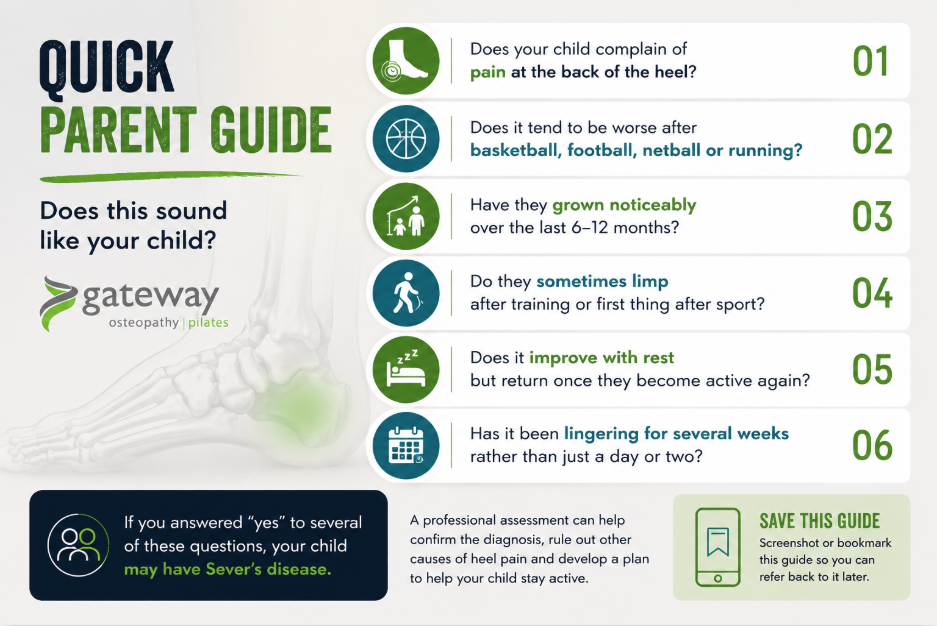
At first it’s only mentioned after basketball training or a weekend football game. A few days later your child starts limping as they walk back to the car. Then one morning they complain their heel is sore as soon as they get out of bed, only to seem much better later in the day.
You begin wondering whether they’ve bruised their heel, whether they’re simply going through a growth spurt, or whether they’re going to have to stop playing the sport they love.
If that sounds familiar, you’re certainly not alone.
At Gateway Osteopathy in Eltham, heel pain is something we assess regularly in active children. Being located close to the Eltham Wildcats, Australia’s largest junior basketball club, we frequently see young basketballers with this presentation. We also regularly assess footballers, soccer players, netballers competing in the Diamond Valley Netball Association, lacrosse players and children involved in athletics, dance and other running sports.
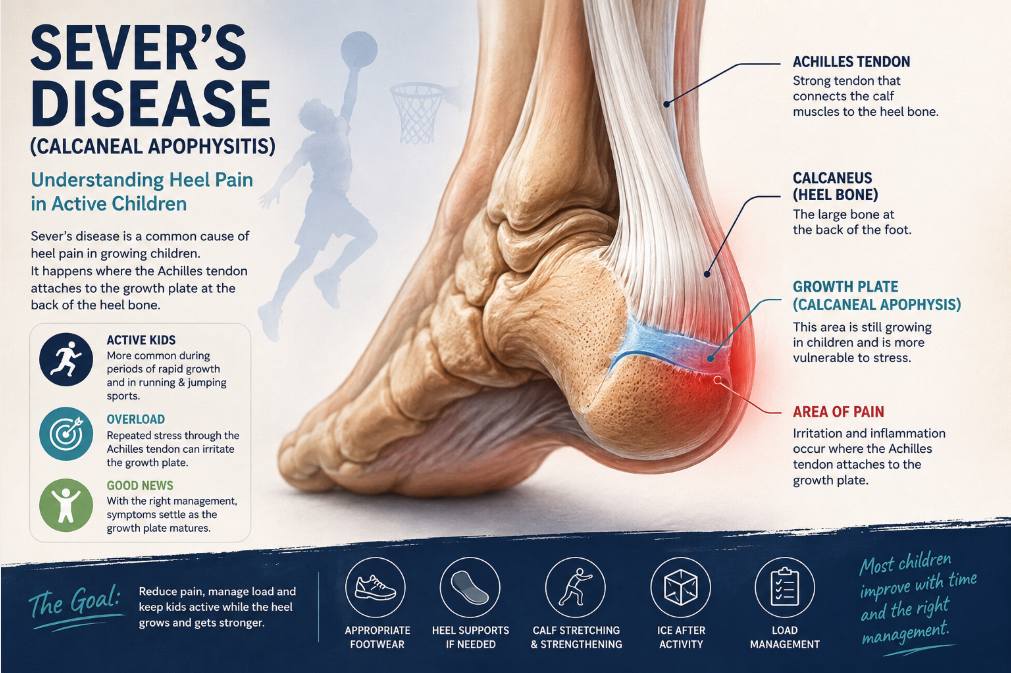
One of the most common causes of heel pain in these young athletes is Sever’s disease, also known as calcaneal apophysitis.
Despite the name, Sever’s disease isn’t actually a disease, and it isn’t something your child has “caught.”
It’s a temporary irritation of the growth plate at the back of the heel that commonly develops during periods of rapid growth in active children.
The first thing I usually tell parents is not to panic.
Although Sever’s disease can certainly be painful and frustrating, it does not permanently damage the heel. In the overwhelming majority of children, symptoms settle as the growth plate matures, although they may come and go during periods of rapid growth and increased sporting activity.
The good news is that children are remarkably resilient. With the right advice, sensible activity modification and a little patience, most are back enjoying the activities they love without any lasting problems.
The challenge usually isn’t whether your child will recover.
The challenge is understanding why the pain has developed, why it seems to come and go, and how to help them remain involved in the sports they love while their symptoms settle.
That’s exactly what this guide is designed to help you understand.
My Clinical Tip
One of the things I’ve learnt over the years is that parents often arrive feeling guilty that they may have “missed something” or “left it too long.”
Fortunately, that’s rarely the case.
Most children continue playing sport for weeks before anyone realises the heel pain isn’t simply settling on its own. The important thing isn’t how quickly the condition is recognised, but understanding what’s happening and having a sensible plan to move forward.
Why does it happen?
One of the first questions parents ask is:
“Why has this suddenly started?”
In reality, it often hasn’t.
Sever’s disease usually develops gradually rather than appearing overnight. Many parents tell me their child complained of heel pain once or twice after sport before the symptoms slowly became more frequent. Looking back, they often realise there wasn’t one particular injury at all.
Instead, it’s usually a combination of growth and load.
During childhood, the heel bone is still developing. At the back of the heel is a growth plate (called the calcaneal apophysis) where the Achilles tendon attaches. While this area is growing, it appears to be more sensitive to the repeated forces created by running, jumping and changing direction.
Now think about the typical week of an active child.
They might train with the Eltham Wildcats during the week, play a game on the weekend, kick the football in the backyard, run around at school during lunchtime, then spend Sunday riding bikes or jumping on the trampoline with friends.
None of those activities are a problem on their own.
In fact, they’re exactly the sort of activities we want children to enjoy.
However, when they’re combined with a period of rapid growth, the developing heel can sometimes struggle to keep up with the demands being placed upon it.
One explanation is that during a growth spurt, bones can grow a little faster than muscles and tendons are able to adapt. The calf muscles may become relatively tighter for a period of time, increasing the pull of the Achilles tendon where it attaches to the growing heel.
For children who love running and jumping sports, that extra demand may be enough to irritate the growth plate.
Although we commonly see Sever’s disease in young basketballers from the Eltham Wildcats, the pattern is remarkably similar across many sports. Footballers, netballers competing in the Diamond Valley Netball Association, soccer players, lacrosse players, gymnasts, dancers and track athletes all place repeated load through the heel.
The sport itself isn’t usually the problem.
It’s the combination of a growing body and repeated loading that often explains why symptoms develop.
One of the things that can make Sever’s disease confusing is that it rarely follows a straight line.
Your child may have two or three excellent weeks before the pain suddenly returns after a basketball tournament, a school athletics carnival, a weekend away full of activity or simply another period of rapid growth.
That doesn’t necessarily mean the condition is getting worse.
More often, it’s the heel reminding us that it’s being asked to cope with more than it’s currently comfortable managing.
My Clinical Tip
One of the first questions I’ll often ask is whether your child has grown noticeably over the last six to twelve months.
Parents are frequently surprised when they realise the heel pain started around the same time they needed a new pair of school shoes or their sports uniform suddenly became too small.
It isn’t unusual for a parent to pause for a moment before saying,
“Now that you mention it, he’s grown about five centimetres since Christmas.”
Those observations don’t diagnose Sever’s disease, but they often provide valuable context and help explain why symptoms seem to have appeared out of nowhere.
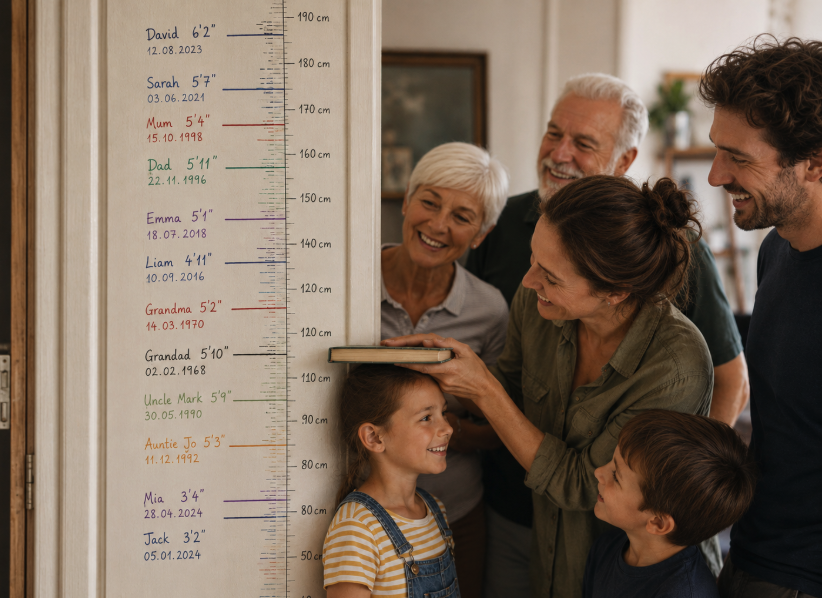
For that reason, I often encourage families to continue one of those wonderful traditions many of us grew up with—marking children’s heights on the back of a wardrobe or pantry door.
As children get older, those pencil marks often become a source of family nostalgia. Grandparents compare their heights, siblings compete to see who’s catching up, and parents remember when they were measured in exactly the same place.
Interestingly, those marks can also become a surprisingly useful record of growth. Looking back, many families realise their child had grown several centimetres in the months leading up to the onset of heel pain.
Understanding the relationship between growth and activity helps explain why symptoms often come and go. More importantly, it helps parents understand why management is usually about temporarily modifying activity rather than avoiding it altogether.
Could it be Severs Disease?
One of the reasons Sever’s disease can be confusing is that it doesn’t always behave the way parents expect.
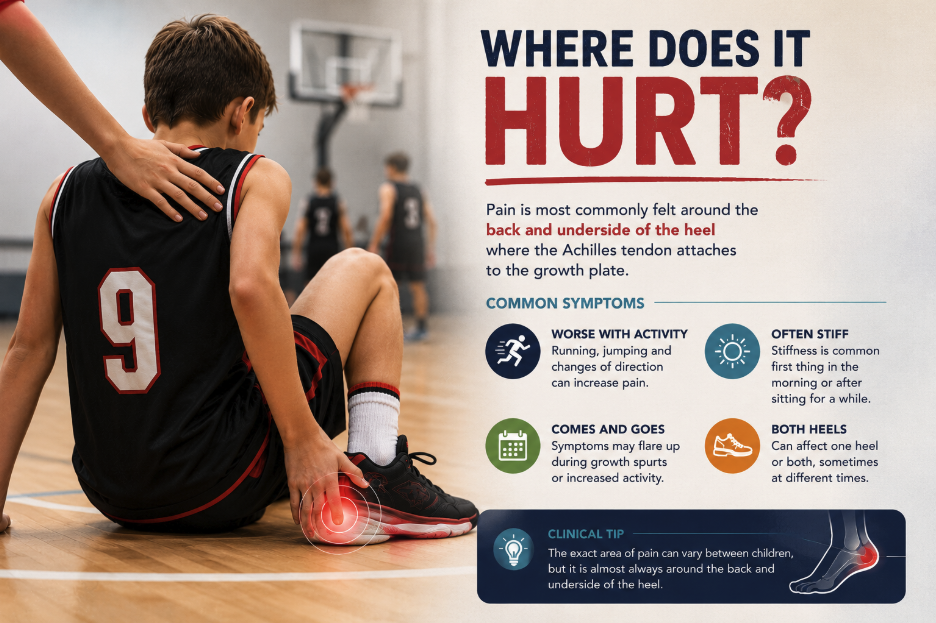
Unlike many injuries, children often continue to run, jump and play sport despite having quite significant heel pain. It’s often only afterwards that they begin to complain.
Parents frequently tell me things like:
“He was fine during basketball, but he was limping back to the car afterwards.”
“She says it only hurts after netball.”
“He wakes up sore in the morning, but by the time he’s at school he seems much better.”
“We thought he’d just bruised his heel.”
“It started in one heel, but now the other one is beginning to hurt as well.”
If you’ve heard your child say something similar, Sever’s disease may be one possible explanation.
Typically, the pain is felt around the back or underside of the heel and is aggravated by running, jumping and repeated changes of direction. Some children notice stiffness when they first get out of bed, while others are more aware of discomfort after sitting for a while before getting up again.
One of the most frustrating aspects for families is that symptoms often fluctuate.
Your child may seem almost completely better one week, only to experience another flare-up after a basketball tournament, a busy weekend of sport or another noticeable growth spurt.
Fortunately, that doesn’t necessarily mean they’re going backwards.
It often simply reflects the changing demands being placed on a growing body.
How Do We Diagnose Sever’s Disease?
One of the most reassuring parts of an assessment is finally understanding why your child’s heel is sore.
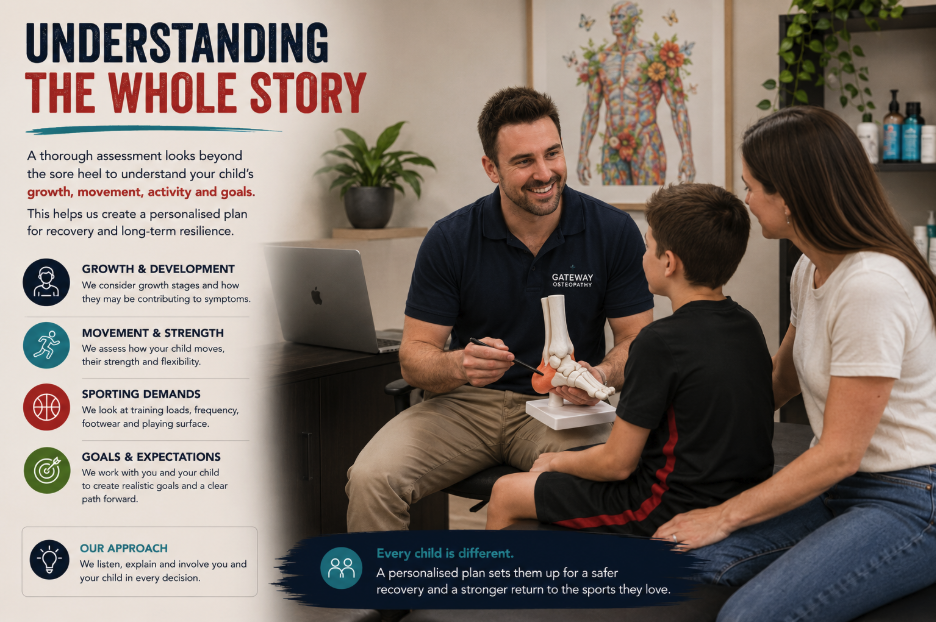
Before I even examine the heel, I’ll usually spend time talking with both you and your child.
I’ll ask when the pain started, whether they’ve grown recently, what sports they play, whether their training load has changed, what activities aggravate the pain and whether anything seems to make it feel better.
Sometimes the answers come from parents.
Sometimes they come from the child.
Both perspectives are important.
The examination itself involves much more than simply pressing on the sore area.
I’ll assess where the pain is located, look at ankle movement, calf flexibility, foot posture and walking, and where appropriate, watch your child move. I’ll also consider factors such as footwear, recent changes in activity and anything else that may be contributing to the load through the heel.
The aim isn’t simply to put a name on the problem.
It’s to understand why this particular child has developed symptoms and what practical changes are most likely to help.
Do All Children Need an X-ray?
Usually not.
Sever’s disease is most commonly diagnosed from your child’s history and a thorough physical examination.
In fact, the appearance of the heel growth plate on an X-ray varies considerably between healthy children, meaning an X-ray often doesn’t provide a clear answer on its own.
However, there are situations where imaging or referral is appropriate.
If your child’s symptoms aren’t following the typical pattern, the pain is in an unusual location, they’ve experienced a significant injury, or there are findings that suggest another condition may be present, I’ll discuss whether further investigation is warranted and communicate with your GP or another healthcare professional where appropriate.
How Do We Know It Isn’t Something Else?
Parents ask me this question all the time, and it’s a very reasonable one.
Although Sever’s disease is one of the most common causes of heel pain in active children, it certainly isn’t the only cause.
Part of my job is recognising when the pieces fit together…
and just as importantly, recognising when they don’t.
When I assess a child, I’m not simply asking,
“Does this look like Sever’s disease?”
I’m also asking,
“Is there anything about this presentation that doesn’t fit?”
The location of the pain, your child’s age, recent growth, sporting activities, the way the symptoms behave and the findings on examination all help build the clinical picture.
When those pieces fit together, the diagnosis is often quite straightforward.
Occasionally, however, something doesn’t quite add up.
Pain that occurs at night, significant swelling, an inability to bear weight, symptoms following a major injury, persistent worsening despite appropriate management, or pain in an unusual location may all prompt me to think more broadly and consider whether further investigation or referral is appropriate.
Fortunately, presentations like this are uncommon.
Most active children between 8 and 14 years of age who develop heel pain during a growth spurt have a history and examination that are very consistent with Sever’s disease.
Perhaps the most reassuring thing I can offer parents is that a thorough assessment isn’t simply about confirming a diagnosis.
It’s about making sure we’re not missing something that deserves a different approach.
My Clinical Tip
One of the things I often say to parents is:
“I’d much rather spend time reassuring you that this behaves exactly like Sever’s disease than simply assume every child with heel pain has the same condition.”
Every child deserves an individual assessment. Sometimes that assessment confirms what we expected. Occasionally it changes the direction entirely. Either way, families leave with a much clearer understanding of what’s happening and a sensible plan moving forward.
Helping your Child Stay Active
One of the first questions almost every parent asks is:
“Do they have to stop playing sport?”
Fortunately, the answer is not usually.
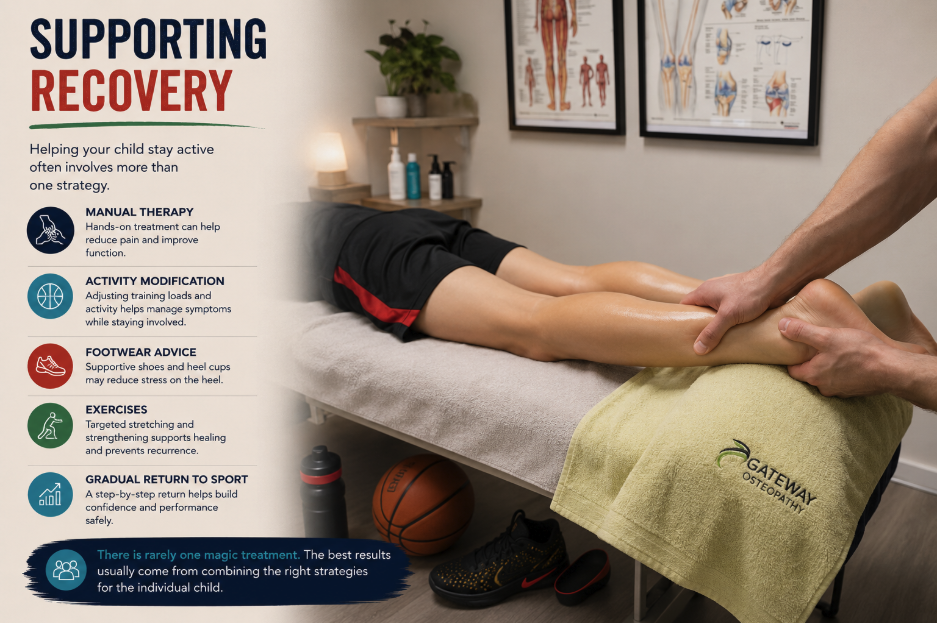
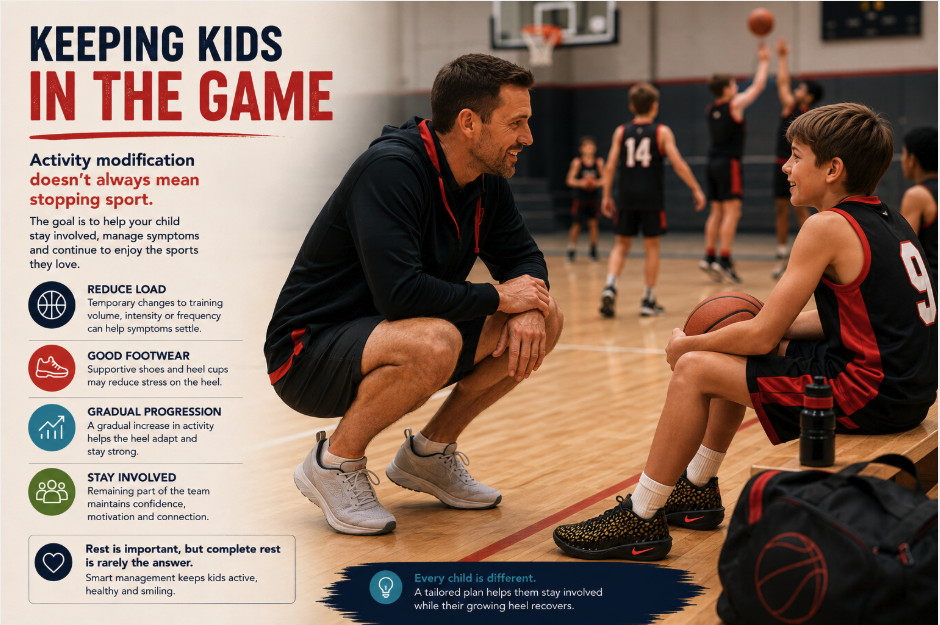
The aim isn’t to wrap children in cotton wool or stop them doing the activities they love. Instead, it’s to help them remain as active as possible while allowing the irritated growth plate time to settle.
Every child is different.
A representative basketballer training four nights a week places very different demands on their body compared with a child who enjoys one game of football each weekend. The right plan depends on your child’s symptoms, their sporting commitments and, most importantly, how they’re responding.
Listen to the Symptoms
If there’s one message I’d like every parent to take away from this guide, it’s this:
Let your child’s symptoms guide the plan.
Children don’t usually need complete rest.
At the same time, continually pushing through increasing pain isn’t likely to help either.
Most of the time, the answer lies somewhere in the middle.
That might mean reducing training for a few weeks, sitting out one session while still playing on the weekend, limiting extra practice at home, or temporarily modifying drills that involve large amounts of running and jumping.
The goal isn’t to avoid activity altogether.
It’s to reduce the load enough for the heel to settle before gradually increasing activity again.
One of the questions I’ll often ask at a review appointment is:
“Is your child coping better with the same amount of activity than they were two weeks ago?”
If the answer is yes, that’s usually a good sign they’re adapting well and may be ready to slowly progress their activity again.
Small Changes Can Make a Big Difference
Sometimes relatively simple changes can make sport much more comfortable.
Depending on your child’s presentation, we might discuss:
- supportive footwear with good cushioning
- whether they’ve recently outgrown their shoes
- heel cups or heel lifts
- temporary taping
- gentle calf stretching where appropriate
- progressive strengthening exercises as symptoms improve
None of these strategies are designed to “fix” the growth plate itself.
Instead, they’re aimed at reducing the stress passing through the heel while allowing your child to remain involved in their normal activities wherever possible.
Can Hands-On Treatment Help?
Parents often ask whether massage or hands-on treatment has a role.
Current research specifically investigating manual therapy for Sever’s disease is limited, so we can’t confidently say that it changes the natural course of the condition.
However, that’s only part of the story.
In my own clinical experience, many children report worthwhile symptomatic relief following supportive treatments such as calf muscle massage, gentle mobilisation of the foot and ankle, taping and other osteopathic techniques.
These treatments aren’t intended to change the growth plate itself.
Rather, they may help reduce discomfort, improve movement and make day-to-day activities more comfortable while the condition runs its natural course.
As our understanding of children’s musculoskeletal conditions continues to evolve, I’m hopeful we’ll continue to see more high-quality research exploring the role manual therapy may play alongside activity modification, exercise and other conservative treatments.
What About Pain Relief?
It’s a question almost every parent asks.
Simple pain-relieving or anti-inflammatory medications may have a role in helping some children remain comfortable, particularly during periods when symptoms are more noticeable.
Whether medication is appropriate depends on your child’s age, medical history and individual circumstances.
If you’re considering pain relief, I’d encourage you to speak with your GP or pharmacist. They can advise whether medication is appropriate and how it should be used safely.
It’s also worth remembering that medication helps manage symptoms—it doesn’t remove the reason the heel has become irritated.
Even if your child feels more comfortable, it’s still important to listen to what the heel is telling you and adjust activity if symptoms continue to increase.
Returning to Sport
One of the most rewarding parts of treating Sever’s disease is watching children regain the confidence to enjoy their sport again.
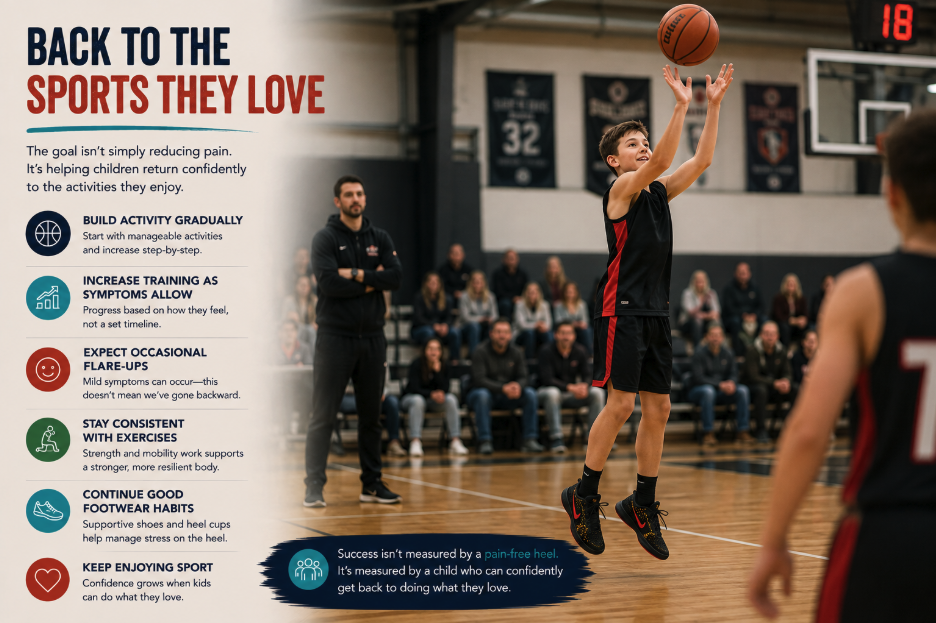
Returning to sport is rarely an all-or-nothing decision.
As symptoms improve, activity is gradually increased. Some weeks will be better than others, particularly during periods of rapid growth, and occasional flare-ups are completely normal.
A temporary increase in pain doesn’t necessarily mean your child has caused more damage.
More often, it’s simply useful feedback that the heel has been asked to do a little more than it was ready for.
With patience, sensible activity modification and an individualised plan, the vast majority of children return to unrestricted sport and leave this temporary stage of growth behind.
My Clinical Tip
Children who love their sport don’t simply need to be told to stop.
They need a plan.
A good management plan allows them to remain involved where possible, understand what their symptoms are telling them and gradually build back to full participation with confidence.
How can and Osteopath Help?
By the time many families come to see me, they’ve often already tried a few things.
They may have rested from sport for a week or two, bought a new pair of basketball shoes, tried stretching the calf muscles, searched online for answers or simply hoped the pain would settle on its own.
Sometimes those strategies are enough.
Other times, parents are left wondering whether they’re managing the condition appropriately, whether their child is doing too much or too little, or whether they’re missing something more serious.
That’s where a thorough assessment can help.
A consultation isn’t just about treating a sore heel.
It’s about understanding why your child has developed symptoms and helping your family confidently navigate the weeks or months ahead.
Every child is different.
Some children simply need reassurance that they’re dealing with a common growth-related condition.
Others benefit from guidance around modifying training loads, progressing back to sport, selecting appropriate exercises or making simple changes to footwear.
Occasionally, an assessment suggests the presentation isn’t typical of Sever’s disease at all, and further investigation or referral is the most appropriate next step.
One of the things I enjoy most about treating children is taking the time to explain what’s happening in language that both parents and children can understand.
When children understand why they’re being asked to make temporary changes, they’re often much more willing to take ownership of their recovery.
As a parent myself, I know my own children don’t always listen to me about health, even when I’m convinced I’m giving excellent advice.
Sometimes hearing exactly the same explanation from someone outside the family is enough for it to click.
It’s amazing how often a child leaves the consultation repeating back to Mum or Dad the very advice they’ve been hearing at home for the past two weeks.
Sometimes they simply need to hear it from someone different.
That conversation can be incredibly valuable.
It often helps children understand that modifying their activity for a short period isn’t a punishment. It’s simply part of helping them get back to doing the things they enjoy.
Depending on your child’s individual presentation, your management plan may include:
- education about Sever’s disease and what to expect
- guidance around activity modification and returning to sport
- advice regarding footwear and heel cups where appropriate
- calf stretching and strengthening exercises
- supportive manual therapy, including calf muscle massage, gentle mobilisation of the foot and ankle, or taping where indicated
- communication with your GP or other healthcare professionals if further investigation is required
Parents often ask me whether hands-on treatment actually helps.
The honest answer is that the published research specifically investigating manual therapy for Sever’s disease remains limited.
However, in my own clinical experience, many children report worthwhile symptomatic relief from supportive treatments when they’re combined with sensible activity modification, education and an appropriate exercise program.
I’m hopeful we’ll continue to see more high-quality research in this area over the coming years, helping us better understand where manual therapy may fit within the overall management of this common childhood condition.
Perhaps the most rewarding part of caring for children with Sever’s disease is seeing their confidence return.
Not simply because their heel hurts less, but because they understand what’s happening, they’re no longer worried about causing damage and they have a clear plan for getting back to the sport they love.
My Clinical Tip
One of the nicest compliments I receive from parents isn’t, “The treatment worked.”
It’s when they say,
“We finally understand what’s been going on.”
Once families understand the condition and have a sensible plan, managing Sever’s disease often becomes far less stressful for both the child and their parents.
.
Frequently Asked Questions.
Will my child grow out of Sever’s disease?
Yes.
The outlook for children with Sever’s disease is excellent. The condition is associated with the growing heel, and symptoms usually settle once the growth plate matures. While the condition can be frustrating during the growing years, it does not permanently damage the heel.
Can my child still play basketball or other sports?
In many cases, yes.
The answer depends on your child’s symptoms rather than the name of the condition.
Many children are able to continue participating with temporary modifications to their training or activity levels. Others may need a short period of reduced loading before gradually increasing their activity again.
The goal isn’t necessarily to stop sport altogether. It’s to help your child remain as active as possible while respecting what their heel is telling them.
Should my child play through pain?
Not usually.
Mild discomfort isn’t necessarily harmful, but continually pushing through increasing pain is rarely helpful.
As a general guide, symptoms should settle reasonably quickly after activity and not continue worsening over time.
If your child is limping significantly, avoiding weight-bearing or struggling with everyday activities, it’s usually sensible to reduce activity and seek an assessment.
Does my child need an X-ray?
Usually not.
Sever’s disease is most commonly diagnosed from your child’s history and a physical examination.
However, if the symptoms aren’t following the expected pattern or another condition needs to be ruled out, imaging or referral may be appropriate.
Will orthotics or heel cups fix the problem?
Not necessarily.
Some children find heel cups or temporary heel lifts very helpful in reducing symptoms, while others notice little difference.
These devices don’t “fix” the growth plate, but they may improve comfort and form one part of an overall management plan.
Orthotics are not required for every child with Sever’s disease. Whether they’re appropriate depends on the individual child and the findings of their assessment.
Does massage or hands-on treatment help?
Current published research specifically investigating manual therapy for Sever’s disease is limited.
However, in my clinical experience, some children report worthwhile symptomatic relief from treatments such as calf muscle massage, gentle mobilisation of the foot and ankle, and other supportive osteopathic techniques when combined with sensible activity modification and an appropriate exercise program.
Should we ice the heel?
Some children find that applying ice after sport provides temporary relief from discomfort.
Ice doesn’t change the underlying growth process, but it may help manage symptoms following periods of increased activity.
As with many supportive measures, the aim is to help your child remain comfortable while the irritated growth plate settles naturally over time.
Is stretching helpful?
Sometimes.
If calf muscle tightness is contributing to your child’s symptoms, gentle stretching may be beneficial.
The key is making sure the exercises are appropriate for your child and introduced at the right stage of their recovery.
Is Sever’s disease caused by growing too quickly?
Not directly.
Growth itself isn’t the problem.
Rather, Sever’s disease appears to develop when the growing heel is exposed to repeated loading during a period of rapid growth. That’s one of the reasons symptoms are often seen in active children who enjoy sports involving running and jumping.
When should I seek professional advice?
It’s worth arranging an assessment if your child’s heel pain is:
- affecting their ability to enjoy sport
- causing them to limp
- continuing to return despite rest
- making everyday activities uncomfortable
- not following the typical pattern you’ve read about here
- causing you to wonder whether something else could be going on
Sometimes the greatest benefit of an assessment isn’t simply receiving a diagnosis.
It’s understanding what’s happening, knowing what to expect and leaving with a clear plan for helping your child stay active.
My Clinical Tip
One of the questions parents often ask at the end of a consultation is,
“When will they be back to normal?”
Unfortunately, there’s no exact timeline because every child grows differently.
Rather than focusing on a specific date, I encourage families to look for gradual progress. If your child is becoming more comfortable with the same amount of activity than they were a few weeks ago, you’re usually heading in the right direction
.
.
Final Thoughts.
If there’s one message I’d like you to take away from this guide, it’s that Sever’s disease is usually a temporary stage of growth, not a permanent injury.
Although it can be painful and frustrating, particularly for children who love their sport, the outlook is generally very good. With a sensible approach to managing activity, most children continue to enjoy the activities they love and make an excellent recovery as they finish growing.
For many families, the greatest challenge isn’t the diagnosis itself. It’s understanding why the pain comes and goes, knowing how much activity is appropriate, and feeling confident that they’re making the right decisions.
That’s why education is such an important part of management.
Once parents understand what’s happening and children understand why temporary changes may be needed, the whole process often becomes far less stressful.
Every child is different. Some recover quickly, while others experience occasional flare-ups during periods of rapid growth or increased sporting activity. That doesn’t necessarily mean anything has gone wrong. More often, it simply means the management plan needs to be adjusted to suit where your child is in their growth journey.
As both an osteopath and a parent, I appreciate how difficult it can be to tell a young athlete they may need to slow down, even for a short time. The good news is that, with the right advice and a clear plan, most children don’t have to choose between doing nothing and pushing through pain.
They simply need guidance to help them navigate this temporary stage of growth.
If your child has persistent heel pain or you’re unsure whether their symptoms are consistent with Sever’s disease, I’d encourage you to seek a professional assessment. Sometimes the greatest reassurance comes not from receiving treatment, but from understanding what’s happening and having confidence in the plan moving forward.


Recent Comments